Articles | Volume 9, issue 5
https://doi.org/10.5194/jbji-9-207-2024
© Author(s) 2024. This work is distributed under
the Creative Commons Attribution 4.0 License.
https://doi.org/10.5194/jbji-9-207-2024
© Author(s) 2024. This work is distributed under
the Creative Commons Attribution 4.0 License.
Musculoskeletal infections associated with Nocardia species: a case series

Ryan B. Khodadadi
Division of Public Health, Infectious Diseases and Occupational Medicine, Department of Medicine, Mayo Clinic, Rochester, Minnesota, USA
Jack W. McHugh
Division of Public Health, Infectious Diseases and Occupational Medicine, Department of Medicine, Mayo Clinic, Rochester, Minnesota, USA
Supavit Chesdachai
Division of Public Health, Infectious Diseases and Occupational Medicine, Department of Medicine, Mayo Clinic, Rochester, Minnesota, USA
Nancy L. Wengenack
Division of Clinical Microbiology, Mayo Clinic, Rochester, Minnesota, USA
Wendelyn Bosch
Division of Infectious Diseases, Mayo Clinic, Jacksonville, Florida, USA
Maria Teresa Seville
Division of Infectious Diseases, Mayo Clinic, Phoenix, Arizona, USA
Douglas R. Osmon
Division of Public Health, Infectious Diseases and Occupational Medicine, Department of Medicine, Mayo Clinic, Rochester, Minnesota, USA
Department of Orthopedic Surgery, Mayo Clinic, Rochester, Minnesota, USA
Elena Beam
Division of Public Health, Infectious Diseases and Occupational Medicine, Department of Medicine, Mayo Clinic, Rochester, Minnesota, USA
Department of Infectious Disease, Cleveland Clinic, Cleveland, Ohio, USA
Related authors
No articles found.
Margaret Pertzborn, Amy L. Van Abel, Trudi Lane, Kristin Cole, Douglas Osmon, Diana J. Schreier, Hilary Teaford, Courtney M. Willis, Anna Woods, Raymund R. Razonable, Abinash Virk, and Christina G. Rivera
J. Bone Joint Infect., 10, 447–450, https://doi.org/10.5194/jbji-10-447-2025, https://doi.org/10.5194/jbji-10-447-2025, 2025
Short summary
Short summary
Patients with bone and joint infections are often sent home before all test results are final. We created a new team-based process to review these results after discharge and take action if needed. In over one-third of cases, changes to treatment were made, some of which prevented serious harm. This approach improves patient safety and shows how teamwork and follow-up after hospital stays can make a meaningful difference in care.
Pansachee Damronglerd, Ryan Bijan Khodadadi, Said El Zein, Jack William McHugh, Omar M. Abu Saleh, Mark Edward Morrey, Aaron Joseph Tande, and Gina Ann Suh
J. Bone Joint Infect., 10, 25–31, https://doi.org/10.5194/jbji-10-25-2025, https://doi.org/10.5194/jbji-10-25-2025, 2025
Short summary
Short summary
Our 10-year multicenter study examines the epidemiology, presentation, management, and outcomes of elbow native joint septic arthritis, a rare condition with risks like reoperation and mortality. Common symptoms included pain and swelling. Synovial fluid white blood cell counts were often low, with monosodium urate crystals also noted. Staphylococcus aureus was the main pathogen, and 72.2 % of patients underwent open debridement.
Christin A. Tiegs-Heiden, Tanner C. Anderson, Mark S. Collins, Matthew P. Johnson, Douglas R. Osmon, and Doris E. Wenger
J. Bone Joint Infect., 8, 99–107, https://doi.org/10.5194/jbji-8-99-2023, https://doi.org/10.5194/jbji-8-99-2023, 2023
Short summary
Short summary
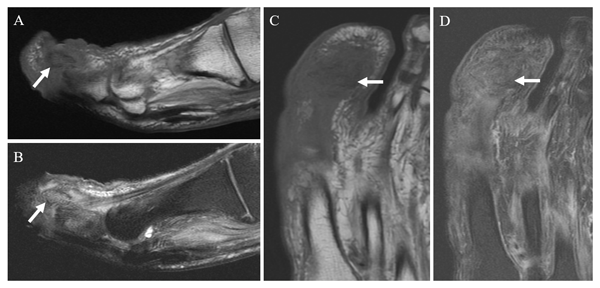
Magnetic resonance imaging (MRI) is an imaging test that is often used in patients with a suspected bone infection in their foot. MRI findings may impact how these patients are treated; thus, it is important to understand the significance of various MRI findings. This study compared different patterns of MRI findings in these patients to their clinical outcomes. Patients with classic features of bone infection on MRI had the worst outcomes, whereas patients without them sometimes healed.
Holly Duck, Suzanne Tanner, Debra Zillmer, Douglas Osmon, and Kevin Perry
J. Bone Joint Infect., 6, 393–403, https://doi.org/10.5194/jbji-6-393-2021, https://doi.org/10.5194/jbji-6-393-2021, 2021
Short summary
Short summary
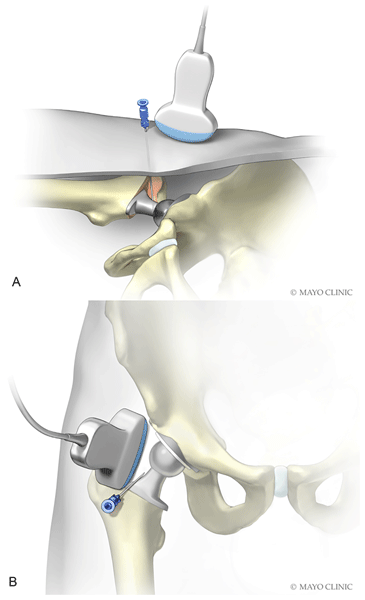
This paper describes an ultrasound guided technique for aspiration of hip arthroplasties that has not been published. We believe this technique is important because it yields useful fluid 99 % of the time with low contamination rate (2 %). Ultrasound, although common in Europe, is gaining popularity in the United States. Besides teaching a useful technique, this paper also discusses findings of lavage-obtained samples which are rarely discussed in other aspiration papers.
Talha Riaz, Mark Collins, Mark Enzler, Marco Rizzo, Audrey N. Schuetz, Julia S. Lehman, Douglas Osmon, and Irene G. Sia
J. Bone Joint Infect., 6, 355–361, https://doi.org/10.5194/jbji-6-355-2021, https://doi.org/10.5194/jbji-6-355-2021, 2021
Short summary
Short summary
Tenosynovitis due to Histoplasma capsulatum in an immunocompromised host warrants special attention. Following surgical debridement, the patient initially improved on antifungal therapy, but as immunosuppression was decreased, she presented with a flare, requiring further debridement. With negative fungal cultures and declining antigenemia, it was felt that her interim worsening was as a consequence of immune reconstitution inflammatory syndrome (IRIS).
Don Bambino Geno Tai, Nathan J. Brinkman, Omar Abu Saleh, Douglas R. Osmon, Matthew P. Abdel, and Christina G. Rivera
J. Bone Joint Infect., 6, 147–150, https://doi.org/10.5194/jbji-6-147-2021, https://doi.org/10.5194/jbji-6-147-2021, 2021
Short summary
Short summary
Antibiotics are frequently used in bone cement during joint replacements or treatment of bone and joint infections. Amikacin is rarely used in bone cement, particularly the liquid formulation. We describe a series of patients in which liquid amikacin was incorporated into bone cement. We did not observe the occurrence of adverse drug reactions definitively attributed to its use. All patients had favorable outcomes.
Cited articles
Charlson, M., Szatrowski, T. P., Peterson, J., and Gold, J.: Validation of a combined comorbidity index, J. Clin. Epidemiol., 47, 1245–1251, https://doi.org/10.1016/0895-4356(94)90129-5, 1994.
Chaussade, H., Lebeaux, D., Gras, G., Catherinot, E., Rammaert, B., Poiree, S., Lecuyer, H., Zeller, V., Bernard, L., and Lortholary, O.: Nocardia Arthritis: 3 Cases and Literature Review, Medicine, 94, e1671, https://doi.org/10.1097/md.0000000000001671, 2015.
Clinical and Laboratory Standards Institute: Susceptibility testing of mycobacteria, Nocardia spp, and other aerobic actinomycetes, 3rd edn., Wayne: Clinical and Laboratory Standards Institute, CLSI guideline M24, 2018a.
Clinical and Laboratory Standards Institute: Performance standards for susceptibility testing of mycobacteria, Nocardia spp, and other aerobic actinomycetes, Wayne: Clinical and Laboratory Standards Institute, CLSI guideline M62, 2018b.
Cortes-Penfield, N., Krsak, M., Damioli, L., Henry, M., Seidelman, J., Hewlett, A., and Certain, L.: How We Approach Suppressive Antibiotic Therapy Following Debridement, Antibiotics, and Implant Retention for Prosthetic Joint Infection, Clin. Infect. Dis., 78, 188–198, https://doi.org/10.1093/cid/ciad484, 2023.
Fazili, T., Bansal, E., Garner, D., Bajwa, V., and Vasudeva, S.: Septic arthritis due to Nocardia: Case report and literature review, Am. J. Med. Sci., 364, 88–91, https://doi.org/10.1016/j.amjms.2022.01.012, 2022.
Harris, P. A., Taylor, R., Thielke, R., Payne, J., Gonzalez, N., and Conde, J. G.: Research electronic data capture (REDCap) – a metadata-driven methodology and workflow process for providing translational research informatics support, J. Biomed. Inform., 42, 377–381, https://doi.org/10.1016/j.jbi.2008.08.010, 2009.
Harris, P. A., Taylor, R., Minor, B. L., Elliott, V., Fernandez, M., O'Neal, L., McLeod, L., Delacqua, G., Delacqua, F., Kirby, J., and Duda, S. N.: The REDCap consortium: Building an international community of software platform partners, J. Biomed. Inform., 95, 103208, https://doi.org/10.1016/j.jbi.2019.103208, 2019.
Minnesota Statutes: https://www.revisor.mn.gov/statutes/cite/144.295 (last access: 9 August 2024), 2023.
Passerini, M., Nayfeh, T., Yetmar, Z. A., Coussement, J., Goodlet, K. J., Lebeaux, D., Gori, A., Mahmood, M., Temesgen, Z., and Murad, M. H.: Trimethoprim-sulfamethoxazole significantly reduces the risk of nocardiosis in solid organ transplant recipients: systematic review and individual patient data meta-analysis, Clin. Microbiol. Infect., 30, 170–177, https://doi.org/10.1016/j.cmi.2023.10.008, 2024.
Restrepo, A. and Clark, N. M.: Nocardia infections in solid organ transplantation: Guidelines from the Infectious Diseases Community of Practice of the American Society of Transplantation, Clin. Transplant., 33, e13509, https://doi.org/10.1111/ctr.13509, 2019.
Takamatsu, A., Yaguchi, T., Tagashira, Y., Watanabe, A., and Honda, H.: Nocardiosis in Japan: a Multicentric Retrospective Cohort Study, Antimicrobial Agents and Chemotherapy, 66, e01890-01821, https://doi.org/10.1128/aac.01890-21, 2022.
Tashiro, H., Takahashi, K., Kusaba, K., Tanaka, M., Komiya, K., Nakamura, T., Aoki, Y., Kimura, S., and Sueoka-Aragane, N.: Relationship between the duration of trimethoprim/sulfamethoxazole treatment and the clinical outcome of pulmonary nocardiosis, Respir. Investig., 56, 166–172, https://doi.org/10.1016/j.resinv.2017.11.008, 2018.
Traxler, R. M., Bell, M. E., Lasker, B., Headd, B., Shieh, W. J., and McQuiston, J. R.: Updated Review on Nocardia Species: 2006–2021, Clin. Microbiol. Rev., 35, e0002721, https://doi.org/10.1128/cmr.00027-21, 2022.
Wilson, J. W.: Nocardiosis: updates and clinical overview, Mayo Clin. Proc., 87, 403–407, https://doi.org/10.1016/j.mayocp.2011.11.016, 2012.
Yetmar, Z. A., Khodadadi, R. B., Chesdachai, S., McHugh, J. W., Challener, D. W., Wengenack, N. L., Bosch, W., Seville, M. T., and Beam, E.: Mortality After Nocardiosis: Risk Factors and Evaluation of Disseminated Infection, Open Forum Infect. Dis., 10, ofad409, https://doi.org/10.1093/ofid/ofad409, 2023.
Yetmar, Z. A., Khodadadi, R. B., Chesdachai, S., McHugh, J. W., Challener, D. W., Wengenack, N. L., Bosch, W., Seville, M. T., and Beam, E.: Epidemiology, Timing, and Secondary Prophylaxis of Recurrent Nocardiosis, Open Forum Infect. Dis., 11, ofae122, https://doi.org/10.1093/ofid/ofae122, 2024.
Short summary
In a multicenter retrospective study of musculoskeletal Nocardia infections (2011–2022), nine cases were identified. Disseminated disease occurred in 33 %, all in solid organ transplant recipients. Surgical intervention was common (89 %), with varied treatment duration (21–467 d). The 1-year mortality was 22%; all fatal cases involved disseminated disease. Localized infection generally had favorable outcomes compared to disseminated disease and requires a collaborative approach for management.
In a multicenter retrospective study of musculoskeletal Nocardia infections (2011–2022),...