the Creative Commons Attribution 4.0 License.
the Creative Commons Attribution 4.0 License.
 | 13 Oct 2026
High preoperative CONUT score is associated with treatment failure and mortality after surgery for acute periprosthetic joint infection: a single-centre retrospective cohort study
Víctor Otero-Naveiro

Blanca Ayuso-García
Silvia Pena-Paz
Ricardo Andrés Rión-Giraldo
María José García-Pais
Alejandro López-Pardo Pardo
Introduction: Acute periprosthetic joint infection (PJI) is associated with substantial morbidity and mortality. The controlling nutritional status (CONUT) score combines serum albumin, total lymphocyte count, and total cholesterol, and may reflect host vulnerability. This study evaluated whether preoperative CONUT is associated with failure and mortality after surgery for acute PJI.
Methods: We performed a single-centre retrospective cohort study of patients surgically treated for acute postoperative or acute haematogenous hip or knee PJI between 1 January 2013 and 30 November 2024. PJI was defined according to EBJIS criteria. CONUT was calculated from preoperative blood tests and dichotomised as low (< 5; normal to mild) or high (≥ 5; moderate to severe). Outcomes were defined using an adapted MSIS-ORT classification as failure, total failure including death within 1 year, and overall mortality.
Results: Of 169 screened patients, 59 were excluded for missing CONUT data and 90 were included; (46.7 %) had high CONUT. High CONUT was associated with higher failure (35.7 % vs. 10.4 %; p=0.004), total failure (57.1 % vs. 12.5 %; p<0.001), and overall mortality (61.9 % vs. 22.9 %; p<0.001). Adjusted analyses confirmed independent associations with failure (odds ratio (OR) 4.24, 95 % confidence interval (CI) 1.34–13.46; p=0.014), total failure (OR 9.57, 95 % CI 2.91–31.50; p<0.001), and overall mortality (hazard ratio (HR) 2.73, 95 % CI 1.29–5.74; p=0.008).
Conclusions: High preoperative CONUT was associated with failure, total failure, and overall mortality after surgery for acute PJI. It may support risk stratification but should not be viewed solely as a nutritional marker, as its components may reflect systemic inflammation, bacteraemia, and infection severity.
- Article
(1085 KB) - Full-text XML
-
Supplement
(1024 KB) - BibTeX
- EndNote


Periprosthetic joint infection (PJI) remains one of the most serious complications after hip and knee arthroplasty. Registry-based analyses suggest an infection burden close to 1 % in contemporary arthroplasty practice, although rates may be higher in frailer populations: after hip hemiarthroplasty for femoral neck fracture, a recent systematic review reported a pooled deep infection rate of 2.14 %, rising to 2.64 % at 12 months (Springer et al., 2017; Silas et al., 2024). This burden is likely underestimated because debridement, antibiotics, and implant retention (DAIR) procedures are not consistently captured in national registries (Springer et al., 2017; Lenguerrand et al., 2018). PJI is now a leading cause of failure after total knee arthroplasty and an increasingly important cause of revision after total hip arthroplasty, accounting for 21.6 % of knee revisions and 18.2 % of hip revisions in a recent registry-based analysis (Koh et al., 2017; Hauer et al., 2024). Its absolute impact is expected to increase as arthroplasty volumes expand and treated populations become older and more comorbid (Kurtz et al., 2007).
Patients with PJI may require repeated procedures, prolonged antimicrobial treatment, and extended hospitalisation, and may experience persistent functional impairment. Survival is also adversely affected; early PJI after primary total knee arthroplasty has been associated with higher mortality than non-infected controls, reaching 15.7 % at 5 years and 38 % at 10 years (Thompson et al., 2022). More than 20 000 PJIs arising from primary arthroplasties performed in Europe in 2019 were estimated to account for EUR 346 million in reimbursement payments, and septic revision may cost up to three times more than aseptic revision (Alt et al., 2025).
Identifying host-related factors associated with poor outcome is therefore clinically relevant. Malnutrition and impaired immunonutritional status are increasingly recognised as potentially modifiable risk factors in arthroplasty, although reported prevalence varies widely according to the definition used (Cross et al., 2014; Almeida et al., 2024). A recent meta-analysis showed that malnutrition was associated with higher odds of surgical site infection and PJI after total joint arthroplasty (Chen and Chen, 2024). In established PJI, conventional nutritional biomarkers may also provide prognostic information; hypoalbuminaemia is common and has been associated with failure after both one-stage and two-stage revision (Green et al., 2023; Traverso et al., 2023; Li et al., 2024).
The controlling nutritional status (CONUT) score combines serum albumin, total lymphocyte count, and total cholesterol, and was originally developed as a hospital-based nutritional screening tool (de Ulíbarri et al., 2005). These three components are intended to reflect protein reserve, immune-nutritional status, and caloric depletion, respectively. In primary hip and knee arthroplasty, Nutritional Risk Screening 2002 (NRS-2002) and CONUT have been linked to postoperative infectious complications and quality-of-life domains, while admission CONUT has also been associated with 1-year PJI risk after total joint arthroplasty (De Mauro et al., 2026; Guo et al., 2026). In established PJI, moderate-to-severe CONUT has been associated with failure after two-stage exchange (Li et al., 2022). However, the prognostic value of CONUT as a composite host-status marker in acute PJI remains insufficiently defined.
The aim of this study was to determine the prevalence of high CONUT in patients surgically treated for acute hip or knee PJI and to evaluate its association with treatment failure and mortality alongside conventional inflammatory biomarkers and established host-assessment tools.
2.1 Study design and setting
A retrospective cohort study was conducted using the institutional database of the Bone and Joint Infection Unit. All consecutive adult patients surgically treated for acute hip or knee PJI at a tertiary referral centre between 1 January 2013 and 30 November 2024 were screened for eligibility.
2.2 Patient selection
Acute postoperative PJI was defined as infection occurring within 3 months of the index arthroplasty with symptom duration of ≤ 3 weeks. Acute haematogenous PJI was defined as infection with symptom duration of ≤ 3 weeks in a previously well-functioning prosthesis. PJI was defined according to EBJIS criteria; cases fulfilling the “infection confirmed” or “infection likely” categories were eligible (McNally et al., 2021). Patients were excluded if they had non-acute infection, no surgical treatment, simultaneous infection of more than one prosthesis, follow-up < 12 months among survivors, or missing laboratory data required for CONUT calculation.
2.3 Surgical management
Surgical strategy reflected routine multidisciplinary practice based on host, implant, soft-tissue, microbiological, and feasibility factors. Procedures were retrospectively classified according to contemporary concepts for acute PJI management (Sigmund et al., 2025). For descriptive analyses, procedures were grouped as implant retention, including DAIR with or without modular component exchange, or implant exchange/removal, including one-stage exchange, two-stage exchange, and resection arthroplasty. Antimicrobial treatment was individualised according to culture results and infectious diseases assessment.
2.4 Variables and CONUT score
Baseline variables included age, sex, relevant comorbidities, index arthroplasty indication, McPherson host grade, Joint-Specific BACH classification (JS-BACH), microbiology, blood cultures, inflammatory biomarkers, and CONUT components. McPherson host grade was dichotomised as A–B versus C, and JS-BACH as low (Uncomplicated) versus high (Complex or Limited Options) (Hotchen et al., 2021). CONUT was calculated using the original scoring system described by de Ulíbarri et al. (2005), based on the preoperative values closest to surgery for serum albumin (0–6 points), total lymphocyte count (0–3 points), and total cholesterol (0–3 points). The resulting total score ranges from 0 to 12 and is categorised as normal (0–1), mild (2–4), moderate (5–8), or severe (9–12). Detailed component cut-points are shown in Table S1 in the Supplement. Patients were dichotomised a priori as low CONUT (< 5) or high CONUT (≥ 5), consistent with the original moderate-to-severe CONUT threshold and previous PJI outcome literature (Li et al., 2022). Total cholesterol was retrieved from routine admission or preoperative blood tests and analysed irrespective of fasting status, in line with European guidance supporting non-fasting lipid profiles for routine clinical assessment (Nordestgaard et al., 2016). Difficult-to-treat pathogens were defined using criteria adapted from Wimmer et al. (2020), including fungi and excluding Cutibacterium acnes (Table S3). C-reactive protein (CRP), CRP-to-albumin ratio (CAR), and neutrophil-to-lymphocyte ratio (NLR) were analysed as exploratory inflammatory biomarkers (Table S5).
2.5 Outcomes
Outcomes were assessed using the Musculoskeletal Infection Society Outcome Reporting Tool (MSIS-ORT), adapted according to Borsinger et al. (2021). Failure comprised tiers 3B–3F: septic revision or reoperation, early aseptic revision, amputation, resection arthroplasty, arthrodesis, or retained spacer. Total failure comprised failure plus death within 1 year from PJI treatment initiation, corresponding to tiers 3B–3F plus 4A. Overall mortality was defined as death from any cause and was analysed as the time from surgery for acute PJI to death or last follow-up. MSIS-ORT categories were mutually exclusive, whereas overall mortality included all deaths from any cause irrespective of the assigned tier.
2.6 Statistical analysis
Continuous variables were assessed for normality and are presented as mean ± standard deviation or median with interquartile range. Categorical variables are reported as frequencies and percentages. Comparisons between groups were performed using the student's t test or Mann–Whitney U test for continuous variables, and the χ2 test or Fisher's exact test for categorical variables, as appropriate.
Multivariable logistic regression was used to identify factors independently associated with failure and total failure. Failure-free survival, total failure-free survival, and overall survival were estimated using Kaplan–Meier curves and compared between CONUT groups using the log-rank test. Cox proportional hazards regression was used to analyse overall mortality. Covariates were selected according to clinical relevance and the limited number of events. A sensitivity Cox model analysed CONUT as a continuous variable. Results are reported as odds ratios (ORs) or hazard ratios (HRs) with 95 % confidence intervals (CIs). Statistical analyses were performed using IBM SPSS Statistics for Windows, version 22.0 (IBM Corp., Armonk, NY, USA).
3.1 Baseline characteristics according to CONUT status
A total of 169 patients were screened, of whom 90 were included (86 confirmed infection and 4 infection likely according to EBJIS), after applying the eligibility criteria and excluding cases with missing data required for CONUT calculation (Fig. 1). The cohort comprised 16 hip hemiarthroplasties (17.8 %), 39 total hip arthroplasties (43.3 %), and 35 total knee arthroplasties (38.9 %). Median follow-up was 46.5 months (range, 0–149) overall and 59 months (range, 12–149) among survivors.
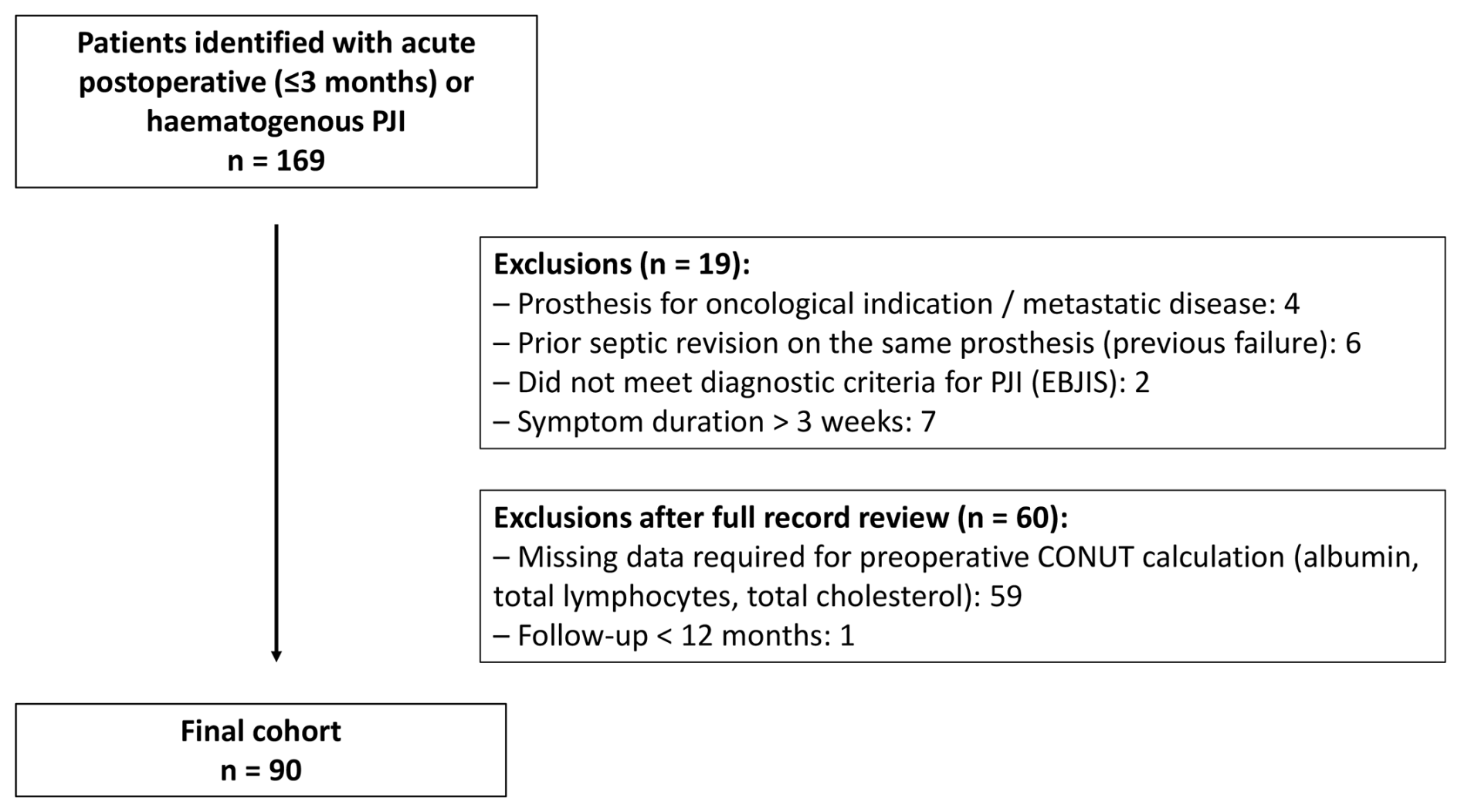
Laboratory measurements were obtained a mean of 3.3 d before surgery (median 2 d, range 0–15). Forty-two patients (46.7 %) were classified as high CONUT and 48 (53.3 %) as low CONUT. High-CONUT patients were older and more frequently aged ≥ 80 years and McPherson host grade C; preoperative CRP was higher in the high-CONUT group. Staphylococcus aureus infection and positive blood cultures were more frequent in the high-CONUT group, while coagulase-negative staphylococci were more common in the low-CONUT group (Tables 1 and S3). In the overall cohort, S. aureus infection was associated with positive blood cultures ( [45.5 %] vs. [14.0 %]; p=0.001).
Fifty-nine patients were excluded because at least one CONUT component was unavailable. Included and excluded patients showed no significant baseline differences; high JS-BACH was numerically more frequent among included patients (74.4 % vs. 61.0 %), without reaching statistical significance (p=0.083) (Table S2).
Table 1Baseline characteristics according to CONUT group.
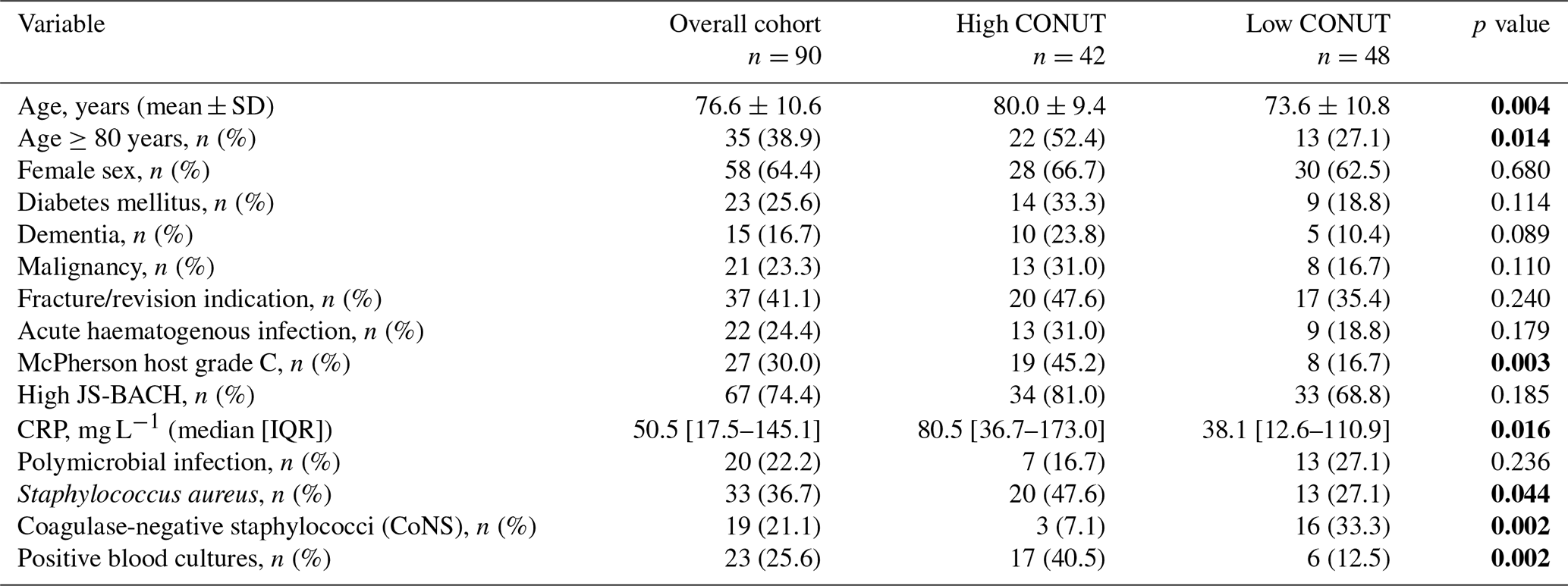
Bold indicates statistically significant differences (p<0.05). CONUT: controlling nutritional status; SD: standard deviation; IQR: interquartile range; CRP: C-reactive protein; CoNS: coagulase-negative staphylococci; JS-BACH: Joint-Specific BACH classification.
3.2 Surgical management and treatment results
Treatment strategies were DAIR with modular parts exchange (DAIR-WMPE) in patients (44.4 %), DAIR without modular exchange (DAIR-WO) in (12.2 %), one-stage exchange in (15.6 %), two-stage exchange in (23.3 %), and resection arthroplasty in (4.4 %). Overall, patients (56.7 %) underwent implant retention and (43.3 %) underwent implant exchange/removal; implant retention was not associated with failure, total failure, or overall mortality (Table 2).
Total failure rates were (25.0 %) after DAIR-WMPE, (54.5 %) after DAIR-WO, (28.6 %) after one-stage exchange, (28.6 %) after two-stage exchange, and (100 %) after resection arthroplasty. These treatment-specific rates were considered descriptive because of small subgroups and confounding by indication.
3.3 Outcome distribution and univariate associations
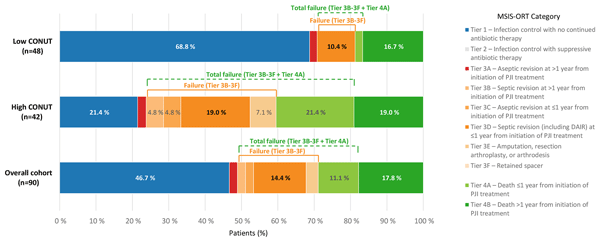
According to MSIS-ORT, Tier 1 was achieved in patients (46.7 %) at final follow-up (median, 46.5 months; range, 0–149). No patients were classified as Tier 2 or Tier 3F. Failure occurred in 20 patients (22.2 %), total failure in 30 (33.3 %), and overall mortality in 37 (41.1 %). High CONUT was associated with higher failure (35.7 % vs. 10.4 %; p=0.004), total failure (57.1 % vs. 12.5 %; p<0.001), and overall mortality (61.9 % vs. 22.9 %; p<0.001) (Fig. 2; Table S4).
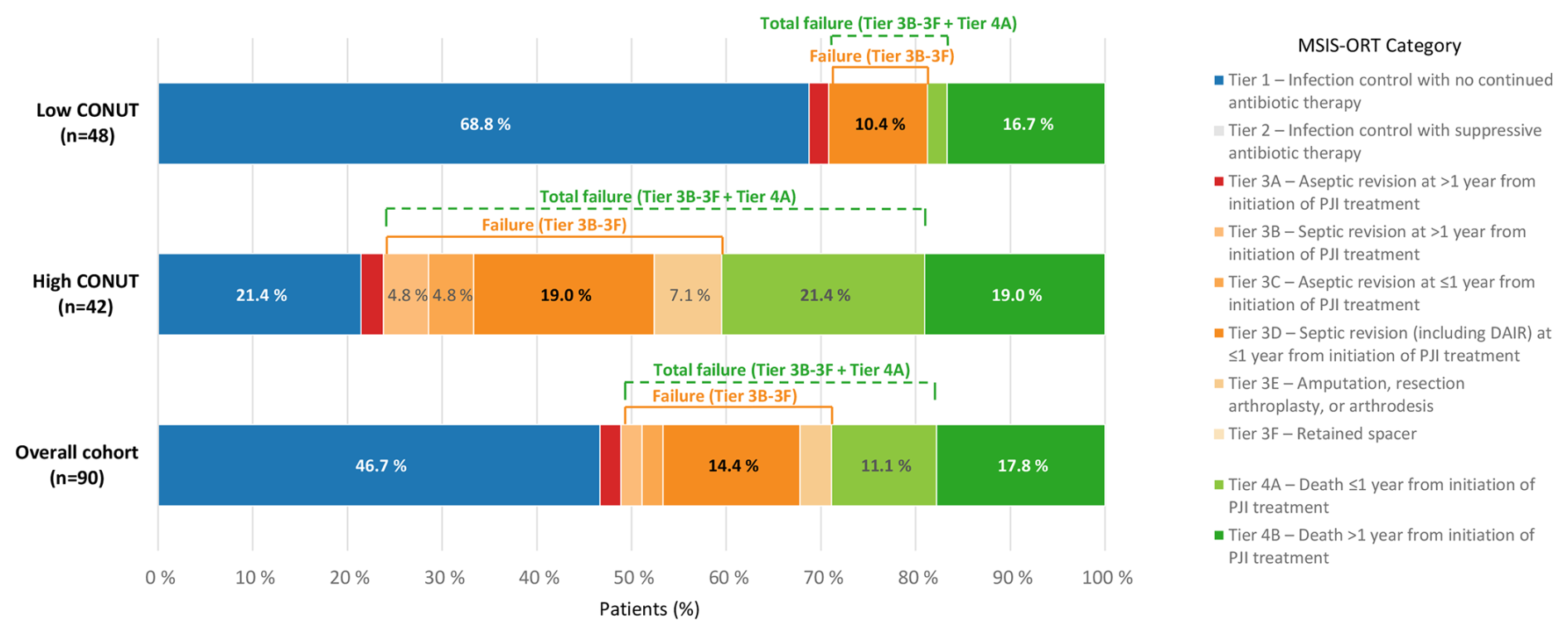
Figure 2MSIS-ORT distribution according to CONUT status. Stacked bar chart showing mutually exclusive MSIS-ORT categories according to preoperative CONUT group. MSIS-ORT: Musculoskeletal Infection Society Outcome Reporting Tool; CONUT: controlling nutritional status; PJI: periprosthetic joint infection; DAIR: debridement, antibiotics, and implant retention.
In univariate analyses, high CONUT showed the most consistent association across outcomes (Table 2). Diabetes mellitus was associated with all three outcomes; McPherson host grade C, high JS-BACH, malignancy, and fracture/revision indication with total failure; and age with overall mortality. CRP, CAR, and NLR showed no consistent association across outcomes (Table S5).
Table 2Main univariate associations with the study outcomes. For categorical variables, data are presented as events/total (%) for the category vs. the reference group; continuous data are mean ± SD or median [IQR] for patients with vs. without the outcome.
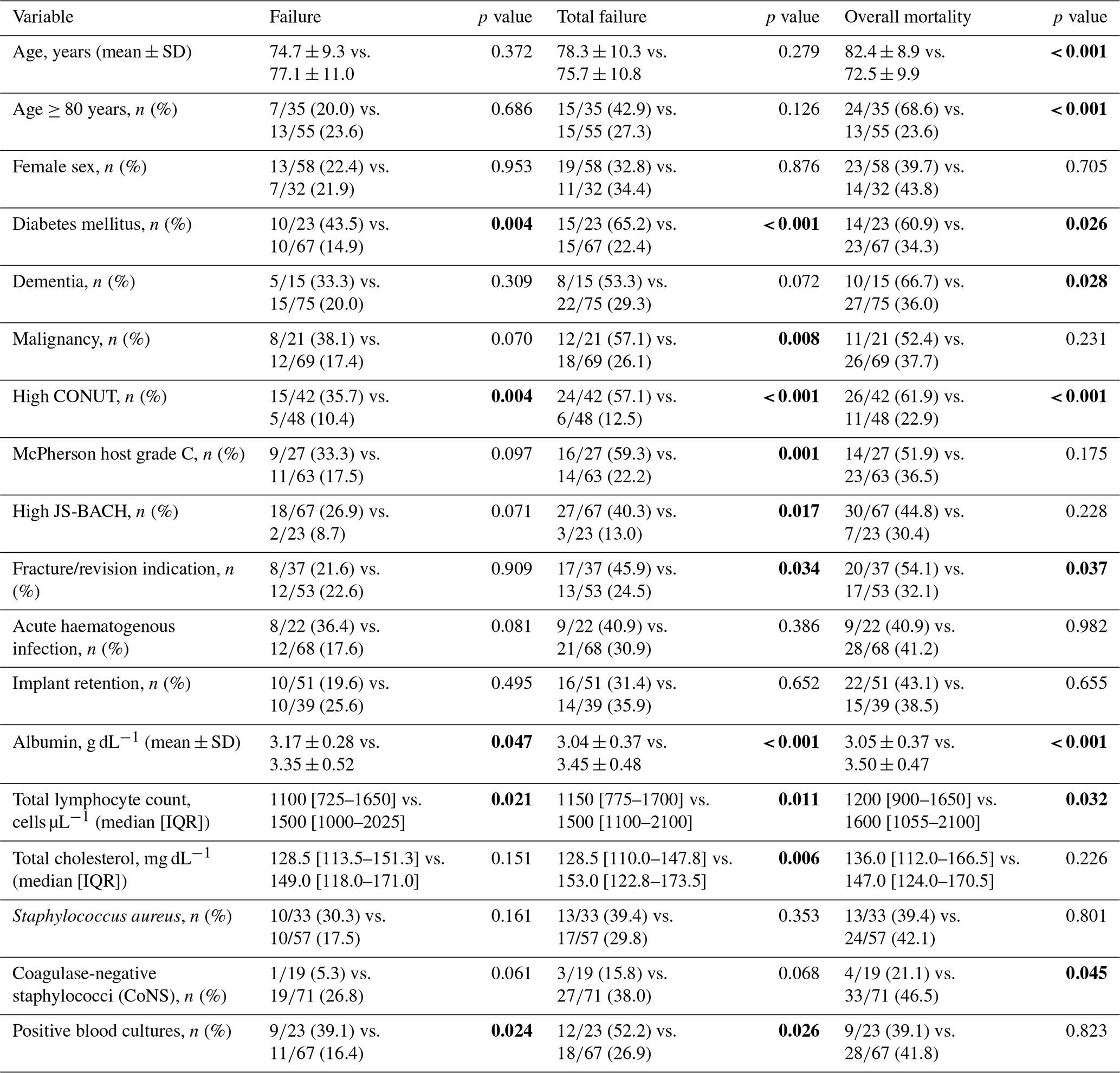
Bold indicates statistically significant differences (p<0.05). CONUT: controlling nutritional status; SD: standard deviation; IQR: interquartile range; JS-BACH: Joint-Specific BACH classification; CoNS: coagulase-negative staphylococci.
3.4 Multivariable analysis
In multivariable logistic regression, high CONUT and diabetes mellitus remained independently associated with failure and total failure. For failure, the adjusted ORs were 4.24 (95 % CI 1.34–13.46; p=0.014) for high CONUT and 3.81 (95 % CI 1.25–11.59; p=0.019) for diabetes mellitus. For total failure, high CONUT (OR 9.57, 95 % CI 2.91–31.50; p<0.001), diabetes mellitus (OR 9.62, 95 % CI 2.56–36.20; p=0.001), and fracture/revision indication (OR 3.78, 95 % CI 1.17–12.27; p=0.027) remained independently associated with the outcome (Table 3).
Kaplan–Meier analyses showed significantly lower failure-free survival in the high-CONUT group (15/42 vs. 5/48 events; log-rank χ2=11.140; p=0.001), lower total-failure-free survival (24/42 vs. 6/48 events; log-rank χ2=20.623; p<0.001), and lower overall survival (26/42 vs. 11/48 deaths from any cause; log-rank χ2=16.233; p<0.001). Median overall survival was 42.3 months (95 % CI 27.1–57.4) in the high-CONUT group and was not reached in the low-CONUT group.
In the Cox model for overall mortality, older age (HR 1.13 per year, 95 % CI 1.07–1.19; p<0.001), diabetes mellitus (HR 3.43, 95 % CI 1.63–7.22; p=0.001), fracture/revision indication (HR 2.26, 95 % CI 1.09–4.69; p=0.029), and high CONUT (HR 2.73, 95 % CI 1.29–5.74; p=0.008) were independently associated with overall mortality (Fig. 3; Table 3). In an exploratory sensitivity Cox model replacing high CONUT with continuous CONUT, each 1-point increase in CONUT remained associated with higher overall mortality (HR 1.34, 95 % CI 1.14–1.57; p<0.001), together with older age (HR 1.13 per year, 95 % CI 1.07–1.19; p<0.001), diabetes mellitus (HR 4.25, 95 % CI 2.01–9.01; p<0.001), and fracture/revision indication (HR 2.18, 95 % CI 1.04–4.55; p=0.039).

Figure 3Kaplan–Meier curves for outcomes according to preoperative CONUT status. Kaplan–Meier curves showing (a) failure-free survival, (b) total failure-free survival, and (c) overall survival, after surgery for acute PJI. Tick marks indicate censored observations. PJI: periprosthetic joint infection; CONUT: Controlling Nutritional Status.
Table 3Final multivariable models.
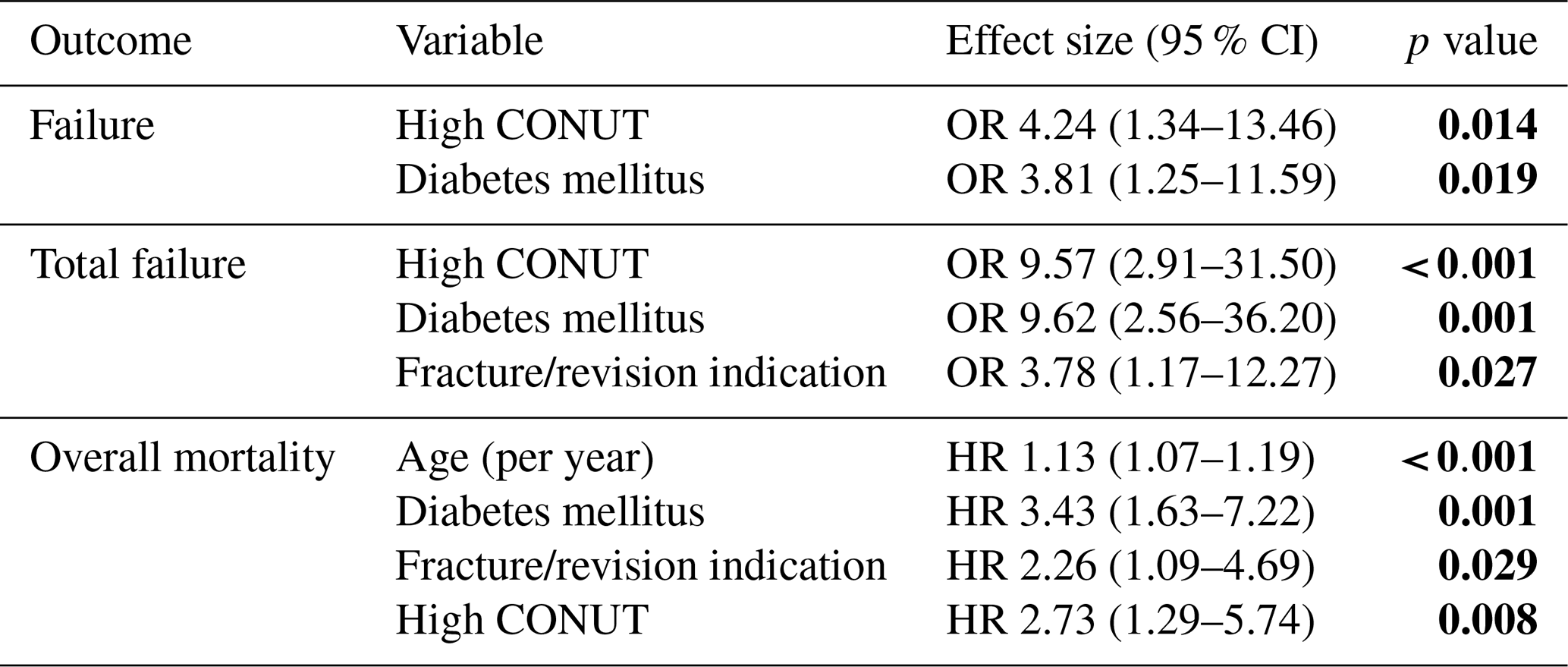
Bold indicates statistically significant associations (p<0.05). OR: odds ratio; HR: hazard ratio; CI: confidence interval; CONUT: controlling nutritional status.
High preoperative CONUT identified patients with worse crude and time-to-event outcomes after surgery for acute PJI and remained independently associated with failure, total failure, and overall mortality after adjustment. The sensitivity analysis using continuous CONUT showed a similar association with overall mortality, consistent with previous evidence of increasing PJI-related risk at higher scores (Li et al., 2022; Guo et al., 2026). These findings support CONUT as a marker of preoperative host vulnerability, although the limited number of events warrants cautious interpretation.
Previous studies similarly linked hypoalbuminaemia with poor outcomes in established PJI. After one-stage septic revision, Traverso et al. (2023) found hypoalbuminaemia to be the only independent predictor of failure (OR 5.64), whereas total lymphocyte count and their combined malnutrition definition were not associated with outcome. Green et al. (2023) reported higher failure after first-stage resection in patients with albumin < 3.5 g dL−1 (adjusted OR 2.50), and Li et al. (2024) found that hypoalbuminaemia at both the first stage and reimplantation was associated with failure, with worse outcomes when it persisted until reimplantation.
In our cohort, CRP, CAR, and NLR did not show consistent associations across outcomes; Hong et al. (2019) similarly found no association between preoperative CAR and failure after two-stage exchange. Although this does not diminish their diagnostic or monitoring value, isolated inflammatory indices may provide a less consistent prognostic signal than composite host-response measures (Ali et al., 2024). High-CONUT patients more frequently had Staphylococcus aureus infection and positive blood cultures, whereas coagulase-negative staphylococci were more common in the low-CONUT group. The association between S. aureus and positive blood cultures was consistent with a more systemic infection phenotype. This accords with Campbell et al. (2022), who linked low albumin with culture-confirmed S. aureus musculoskeletal infection; and Li et al. (2024), who associated hypoalbuminaemia in chronic PJI with potentially more virulent organisms, including S. aureus. Hypoalbuminaemia and high CONUT may therefore reflect both host vulnerability and the systemic response to a more invasive infection phenotype, although this interpretation remains exploratory and does not establish causality.
Importantly, CONUT should not be interpreted as a formal diagnosis of malnutrition, particularly in acute PJI. According to the Global Leadership Initiative on Malnutrition (GLIM) framework, malnutrition requires at least one phenotypic and one aetiological criterion, rather than serum-based abnormalities alone (Cederholm et al., 2019). The updated European Society for Clinical Nutrition and Metabolism (ESPEN) guidance makes a similar distinction: albumin is prognostic and may identify patients at increased metabolic risk, but it should not be considered a nutritional marker per se (Weimann et al., 2025).
This distinction is especially relevant in our cohort because CONUT components were measured after symptom onset and close to surgery. In acute infection, systemic inflammation, bacteraemia, metabolic stress, and catabolic activation may impair the host's ability to maintain normal circulating albumin, lymphocyte, and cholesterol levels. Hypoalbuminaemia may reflect the hepatic acute-phase response and reduced albumin synthesis during systemic inflammation (Beyer et al., 2022). Lymphopenia may accompany immune dysregulation and bacteraemia, and total lymphocyte count may correlate poorly with nutritional status in older adults (de Jager et al., 2010; Kuzuya et al., 2005; Wang et al., 2024). Hypocholesterolaemia has also been linked to sepsis severity and mortality, probably reflecting the interaction between inflammation, lipid metabolism, and host response (Taylor et al., 2024). In acute PJI, CONUT may therefore be better understood as a composite host-response marker integrating nutritional and physiological reserve, inflammation, immune dysfunction, and catabolic stress. Without pre-infection measurements, however, we cannot distinguish pre-existing vulnerability from infection-induced deterioration.
Diabetes mellitus was independently associated with all three outcomes, consistent with DAIR literature identifying diabetes among relevant comorbidities (Abbaszadeh et al., 2026). Lin et al. (2022) reported higher reinfection after two-stage revision with HbA1c ≥ 7 %, although no definitive threshold was established. This association is biologically plausible because hyperglycaemia impairs neutrophil chemotaxis, phagocytosis, and bactericidal activity (Jafar et al., 2016). Mortality was also associated with age and fracture/revision indication, indicating that CONUT should complement rather than replace established PJI-specific host and complexity scores such as JS-BACH by adding an objective laboratory-based dimension of host status.
Strengths included the use of EBJIS diagnostic criteria and structured MSIS-ORT outcome assessment. This is relevant because a lack of standardisation in PJI outcome reporting remains a major limitation, and different definitions can substantially alter reported success rates (Borsinger et al., 2021; Tarabichi et al., 2025). The MSIS-ORT allowed transparent reporting of mutually exclusive outcome categories and helped to distinguish failure, total failure, and overall mortality.
The main limitation of this study was the exclusion of otherwise eligible patients because one or more laboratory components required to calculate CONUT were unavailable, which may have introduced selection bias. In our centre, albumin and total cholesterol are usually included in standard morning admission or preoperative laboratory profiles but are not consistently requested in urgent emergency department blood tests. This probably explains why CONUT components were missing in a substantial proportion of patients. However, included patients and those excluded because of missing CONUT components showed no significant differences in baseline demographic, clinical, host-related, inflammatory, microbiological, or blood culture characteristics, mitigating but not eliminating this risk. Other limitations include the retrospective single-centre design, modest sample size, limited number of events, and residual confounding. Surgical treatment was heterogeneous and non-randomised, reflecting routine clinical decision-making; therefore, treatment-specific comparisons should be considered descriptive rather than causal.
High preoperative CONUT was associated with failure, total failure, and overall mortality after surgery for acute hip and knee PJI. As a simple and widely available composite host-status marker, CONUT may support preoperative risk stratification in this high-risk population. However, in acute PJI, CONUT should not be interpreted solely as a nutritional marker because its components may be influenced by systemic inflammation, bacteraemia, and infection severity. Larger multi-centre studies should validate these findings and determine whether targeted optimisation strategies can modify these outcomes.
No custom code was developed for this study. The patient-level dataset is not publicly available because it derives from retrospective medical records and contains sensitive clinical information. Public deposition is not covered by the study's ethical approval and is restricted by confidentiality obligations, institutional policies, and applicable data-protection legislation. Access to an appropriately anonymised and limited dataset may be considered upon reasonable request, subject to prior institutional and research ethics approval.
The supplement related to this article is available online at https://doi.org/10.5194/jbji-11-613-2026-supplement.
Víctor Otero-Naveiro conceived and designed the study, curated the data, performed the primary statistical work, and drafted the paper. Blanca Ayuso-García, Silvia Pena-Paz, Ricardo A. Rión-Giraldo, María José García-Pais, and Alejandro López-Pardo Pardo contributed to the study design, data interpretation, critical revision of the paper, and approval of the final version.
The contact author has declared that none of the authors has any competing interests.
This retrospective cohort study was approved by the Galician Research Ethics Committee (CEImG; CEI 2025/171). The requirement for individual informed consent was waived owing to the retrospective design and use of anonymised data.
Publisher's note: Copernicus Publications remains neutral with regard to jurisdictional claims made in the text, published maps, institutional affiliations, or any other geographical representation in this paper. The authors bear the ultimate responsibility for providing appropriate place names. Views expressed in the text are those of the authors and do not necessarily reflect the views of the publisher.
The authors thank Andrés Blanco Hortas, Instituto de Investigación Sanitaria de Santiago de Compostela (IDIS), for assistance with the statistical analysis.
During paper preparation, the authors used ChatGPT for language editing and formatting support. The authors reviewed and approved all content and take full responsibility for the final article.
This paper was edited by Anna Stefánsdóttir and reviewed by two anonymous referees.
Abbaszadeh, A., Yilmaz, M. K., Izadi, N., Hoveidaei, A. H., Taheriazam, A., Abedi, A. A., and Parvizi, J.: Efficacy of debridement, antibiotics, and implant retention in total hip and knee arthroplasty: a systematic review and meta-analysis, J. Arthroplasty, 41, 19–38, https://doi.org/10.1016/j.arth.2025.05.121, 2026.
Ali, K. A., He, L., Deng, X., Pan, J., Huang, H., and Li, W.: Assessing the predictive value of pre- and post-operative inflammatory markers in patients undergoing total knee arthroplasty, J. Orthop. Surg. Res., 19, 614, https://doi.org/10.1186/s13018-024-05104-0, 2024.
Almeida, P. R., Mokete, L., Sikhauli, N., Mota, A., Ndindwa, B., and Pietrzak, J. R. T.: Malnutrition in total joint arthroplasty: what should the orthopaedic surgeon consider?, EFORT Open Rev., 9, 615–624, https://doi.org/10.1530/EOR-23-0192, 2024.
Alt, V., Szymski, D., Rupp, M., Fontalis, A., Vaznaisiene, D., Marais, L. C., Wagner, C., and Walter, N.: The health-economic burden of hip and knee periprosthetic joint infections in Europe: a comprehensive analysis following primary arthroplasty, Bone Jt. Open, 6, 298–311, https://doi.org/10.1302/2633-1462.63.BJO-2024-0225.R1, 2025.
Beyer, D., Hoff, J., Sommerfeld, O., Zipprich, A., Gaßler, N., and Press, A. T.: The liver in sepsis: molecular mechanism of liver failure and their potential for clinical translation, Mol. Med., 28, 84, https://doi.org/10.1186/s10020-022-00510-8, 2022.
Borsinger, T. M., Pierce, D. A., Hanson, T. M., Werth, P. M., Orem, A. R., and Moschetti, W. E.: Is the proportion of patients with successful outcomes after two-stage revision for prosthetic joint infection different when applying the Musculoskeletal Infection Society Outcome Reporting Tool compared with the Delphi-based consensus criteria?, Clin. Orthop. Relat. Res., 479, 1589–1597, https://doi.org/10.1097/CORR.0000000000001654, 2021.
Campbell, M. P., Mott, M. D., Owen, J. R., Reznicek, J. E., Beck, C. A., Muthukrishnan, G., Golladay, G. J., and Kates, S. L.: Low albumin level is more strongly associated with adverse outcomes and Staphylococcus aureus infection than hemoglobin A1C or smoking tobacco, J. Orthop. Res., 40, 2670–2677, https://doi.org/10.1002/jor.25282, 2022.
Cederholm, T., Jensen, G. L., Correia, M. I. T. D., Gonzalez, M. C., Fukushima, R., Higashiguchi, T., Baptista, G., Barazzoni, R., Blaauw, R., Coats, A., Crivelli, A., Evans, D. C., Gramlich, L., Fuchs-Tarlovsky, V., Keller, H., Llido, L., Malone, A., Mogensen, K. M., Morley, J. E., Muscaritoli, M., Nyulasi, I., Pirlich, M., Pisprasert, V., de van der Schueren, M. A. E., Siltharm, S., Singer, P., Tappenden, K., Velasco, N., Waitzberg, D., Yamwong, P., Yu, J., Van Gossum, A., Compher, C., GLIM Core Leadership Committee, and GLIM Working Group: GLIM criteria for the diagnosis of malnutrition – a consensus report from the global clinical nutrition community, J. Cachexia Sarcopenia Muscle, 10, 207–217, https://doi.org/10.1002/jcsm.12383, 2019.
Chen, Y. and Chen, W.: Association between malnutrition status and total joint arthroplasty periprosthetic joint infection and surgical site infection: a systematic review meta-analysis, J. Orthop. Surg. Res., 19, 660, https://doi.org/10.1186/s13018-024-05165-1, 2024.
Cross, M. B., Yi, P. H., Thomas, C. F., Garcia, J., and Della Valle, C. J.: Evaluation of malnutrition in orthopaedic surgery, J. Am. Acad. Orthop. Surg., 22, 193–199, https://doi.org/10.5435/JAAOS-22-03-193, 2014.
de Jager, C. P. C., van Wijk, P. T. L., Mathoera, R. B., de Jongh-Leuvenink, J., van der Poll, T., and Wever, P. C.: Lymphocytopenia and neutrophil-lymphocyte count ratio predict bacteremia better than conventional infection markers in an emergency care unit, Crit. Care, 14, R192, https://doi.org/10.1186/cc9309, 2010.
De Mauro, D., Comisi, C., Maccauro, V., Balato, G., Meller, S., Di Martino, M., Arduini, F., Maccauro, G., and Vitiello, R.: Malnutrition affects infection rates and quality of life in patients undergoing primary hip and knee arthroplasty: a retrospective study, J. Bone Joint Infect., 11, 139–147, https://doi.org/10.5194/jbji-11-139-2026, 2026.
de Ulíbarri, J. I., González-Madroño, A., de Villar, N. G. P., González, P., González, B., Mancha, A., Rodríguez, F., and Fernández, G.: CONUT: a tool for controlling nutritional status. First validation in a hospital population, Nutr. Hosp., 20, 38–45, 2005.
Green, C. C., Valenzuela, M. M., Odum, S. M., Rowe, T. M., Springer, B. D., Fehring, T. K., and Otero, J. E.: Hypoalbuminemia predicts failure of two-stage exchange for chronic periprosthetic joint infection of the hip and knee, J. Arthroplasty, 38, 1363–1368, https://doi.org/10.1016/j.arth.2023.01.012, 2023.
Guo, H., Yang, Z., Wu, D., Li, C., Ma, M., Wang, T., Zhu, R., Wang, M., Li, S., Wang, Y., Yang, H., Zhang, Y., Zhu, Y., and Wang, J.: Association of admission nutritional status evaluated by the controlling nutritional status score with periprosthetic joint infection after primary total joint arthroplasty: an exploratory analysis, J. Arthroplasty, 41, 1984–1994, https://doi.org/10.1016/j.arth.2025.10.121, 2026.
Hauer, G., Rasic, L., Klim, S., Leitner, L., Leithner, A., and Sadoghi, P.: Septic complications are on the rise and aseptic loosening has decreased in total joint arthroplasty: an updated complication-based analysis using worldwide arthroplasty registers, Arch. Orthop. Traum. Su., 144, 5199–5204, https://doi.org/10.1007/s00402-024-05379-2, 2024.
Hong, C. S., Ryan, S. P., Gabor, J. A., Bergen, M. A., Schwarzkopf, R., and Seyler, T. M.: Predicting success of two-stage exchange for prosthetic joint infection using C-reactive protein/albumin ratio, Adv. Orthop., 2019, 6521941, https://doi.org/10.1155/2019/6521941, 2019.
Hotchen, A. J., Wismayer, M. G., Robertson-Waters, E., McDonnell, S. M., Kendrick, B., Taylor, A., Alvand, A., and McNally, M.: The Joint-Specific BACH classification: a predictor of outcome in prosthetic joint infection, EClinicalMedicine, 42, 101192, https://doi.org/10.1016/j.eclinm.2021.101192, 2021.
Jafar, N., Edriss, H., and Nugent, K.: The effect of short-term hyperglycemia on the innate immune system, Am. J. Med. Sci., 351, 201–211, https://doi.org/10.1016/j.amjms.2015.11.011, 2016.
Koh, C. K., Zeng, I., Ravi, S., Zhu, M., Vince, K. G., and Young, S. W.: Periprosthetic joint infection is the main cause of failure for modern knee arthroplasty: an analysis of 11,134 knees, Clin. Orthop. Relat. R., 475, 2194–2201, https://doi.org/10.1007/s11999-017-5396-4, 2017.
Kurtz, S., Ong, K., Lau, E., Mowat, F., and Halpern, M.: Projections of primary and revision hip and knee arthroplasty in the United States from 2005 to 2030, J. Bone Joint Surg. Am., 89, 780–785, https://doi.org/10.2106/JBJS.F.00222, 2007.
Kuzuya, M., Kanda, S., Koike, T., Suzuki, Y., and Iguchi, A.: Lack of correlation between total lymphocyte count and nutritional status in the elderly, Clin. Nutr., 24, 427–432, https://doi.org/10.1016/j.clnu.2005.01.003, 2005.
Lenguerrand, E., Whitehouse, M. R., Beswick, A. D., Kunutsor, S. K., Burston, B., Porter, M., Blom, A. W., and National Joint Registry for England, Wales, Northern Ireland and the Isle of Man: Risk factors associated with revision for prosthetic joint infection after hip replacement: a prospective observational cohort study, Lancet Infect. Dis., 18, 1004–1014, https://doi.org/10.1016/S1473-3099(18)30345-1, 2018.
Li, Z., Maimaiti, Z., Li, Z.-Y., Fu, J., Hao, L.-B., Xu, C., and Chen, J.-Y.: Moderate-to-severe malnutrition identified by the controlling nutritional status (CONUT) score is significantly associated with treatment failure of periprosthetic joint infection, Nutrients, 14, 4433, https://doi.org/10.3390/nu14204433, 2022.
Li, Z.-Y., Li, Z., Xu, C., Fu, J., Maimaiti, Z., Hao, L.-B., Zhang, Q.-M., and Chen, J.-Y.: Hypoalbuminemia is highly prevalent in patients with periprosthetic joint infection and strongly associated with treatment failure, Orthop. Surg., 16, 2419–2427, https://doi.org/10.1111/os.14162, 2024.
Lin, Y.-C., Lin, Y.-H., Chou, J.-H., Lo, Y.-T., Chang, C.-H., Lee, S.-H., and Lin, S.-H.: Higher reinfection rate after two-stage revision arthroplasty in patients with refractory diabetes mellitus: a retrospective analysis with a minimum ten-year follow up, BMC Musculoskelet. Disord., 23, 990, https://doi.org/10.1186/s12891-022-05964-9, 2022.
McNally, M., Sousa, R., Wouthuyzen-Bakker, M., Chen, A. F., Soriano, A., Vogely, H. C., Clauss, M., Higuera, C. A., and Trebše, R.: The EBJIS definition of periprosthetic joint infection: a practical guide for clinicians, Bone Joint J., 103-B, 18–25, https://doi.org/10.1302/0301-620X.103B1.BJJ-2020-1381.R1, 2021.
Nordestgaard, B. G., Langsted, A., Mora, S., Kolovou, G., Baum, H., Bruckert, E., Watts, G. F., Sypniewska, G., Wiklund, O., Borén, J., Chapman, M. J., Cobbaert, C., Descamps, O. S., Von Eckardstein, A., Kamstrup, P. R., Pulkki, K., Kronenberg, F., Remaley, A. T., Rifai, N., Ros, E., and Langlois, M.: Fasting is not routinely required for determination of a lipid profile: clinical and laboratory implications including flagging at desirable concentration cut-points – a joint consensus statement from the European Atherosclerosis Society and European Federation of Clinical Chemistry and Laboratory Medicine, Eur. Heart J., 37, 1944–1958, https://doi.org/10.1093/eurheartj/ehw152, 2016.
Sigmund, I. K., Ferry, T., Sousa, R., Soriano, A., Metsemakers, W.-J., Clauss, M., Trebse, R., and Wouthuyzen-Bakker, M.: Debridement, antimicrobial therapy, and implant retention (DAIR) as curative strategy for acute periprosthetic hip and knee infections: a position paper of the European Bone & Joint Infection Society (EBJIS), J. Bone Joint Infect., 10, 101–138, https://doi.org/10.5194/jbji-10-101-2025, 2025.
Silas, U., Berberich, C., Anyimiah, P., Szymski, D., and Rupp, M.: Risk of surgical site infection after hip hemiarthroplasty of femoral neck fractures: a systematic review and meta-analysis, Arch. Orthop. Trauma Surg., 144, 3685–3695, https://doi.org/10.1007/s00402-024-05384-5, 2024.
Springer, B. D., Cahue, S., Etkin, C. D., Lewallen, D. G., and McGrory, B. J.: Infection burden in total hip and knee arthroplasties, Arthroplast. Today, 3, 137–140, https://doi.org/10.1016/j.artd.2017.05.003, 2017.
Tarabichi, S., Verhey, J. T., Mont, M. A., Parvizi, J., Bingham, J. S., and Spangehl, M. J.: Lack of standardization in treatment outcomes for periprosthetic joint infection, J. Arthroplasty, 40, 6–7, https://doi.org/10.1016/j.arth.2024.10.001, 2025.
Taylor, R., Zhang, C., George, D., Kotecha, S., Abdelghaffar, M., Forster, T., Dos Santos Rodrigues, P., Reisinger, A. C., White, D., Hamilton, F., Watkins, W. J., Griffith, D. M., and Ghazal, P.: Low circulatory levels of total cholesterol, HDL-C and LDL-C are associated with death of patients with sepsis and critical illness: systematic review, meta-analysis, and perspective of observational studies, eBioMedicine, 100, 104981, https://doi.org/10.1016/j.ebiom.2024.104981, 2024.
Thompson, O., W-Dahl, A., and Stefánsdóttir, A.: Increased short- and long-term mortality amongst patients with early periprosthetic knee joint infection, BMC Musculoskel. Dis., 23, 1069, https://doi.org/10.1186/s12891-022-06024-y, 2022.
Traverso, G., Núñez, J. H., Gehrke, T., and Citak, M.: Hypoalbuminemia increases the risk of failure following one-stage septic revision for periprosthetic joint infection, Arch. Orthop. Traum. Su., 143, 5641–5648, https://doi.org/10.1007/s00402-023-04885-z, 2023.
Wang, Z., Zhang, W., Chen, L., Lu, X., and Tu, Y.: Lymphopenia in sepsis: a narrative review, Crit. Care, 28, 315, https://doi.org/10.1186/s13054-024-05099-4, 2024.
Weimann, A., Bezmarevic, M., Braga, M., Correia, M. I. T. D., Funk-Debleds, P., Gianotti, L., Gillis, C., Hübner, M., Inciong, J. F. B., Jahit, M. S., Klek, S., Kori, T., Laviano, A., Ljungqvist, O., Lobo, D. N., Loinaz Segurola, C., Montroni, I., Reddy, B. R., Saur, N. M., Schweinlin, A., Shi, H.-P., Takeuchi, H., Waitzberg, D. L., Wallengren, O., Wischmeyer, P. E., Ysebaert, D., and Bischoff, S. C.: ESPEN guideline on clinical nutrition in surgery – Update 2025, Clin. Nutr., 53, 222–261, https://doi.org/10.1016/j.clnu.2025.08.029, 2025.
Wimmer, M. D., Hischebeth, G. T. R., Randau, T. M., Gathen, M., Schildberg, F. A., Fröschen, F. S., Kohlhof, H., and Gravius, S.: Difficult-to-treat pathogens significantly reduce infection resolution in periprosthetic joint infections, Diagn. Micr. Infec. Dis., 98, 115114, https://doi.org/10.1016/j.diagmicrobio.2020.115114, 2020.