Articles | Volume 11, issue 4
https://doi.org/10.5194/jbji-11-513-2026
© Author(s) 2026. This work is distributed under
the Creative Commons Attribution 4.0 License.
https://doi.org/10.5194/jbji-11-513-2026
© Author(s) 2026. This work is distributed under
the Creative Commons Attribution 4.0 License.
Reinfection and complication rates in two-stage revision for chronic hip periprosthetic joint infections using the direct anterior approach
Sebastian Simon
Michael Ogon Laboratory for Orthopedic Research, Orthopedic Hospital Vienna Speising, Vienna, Austria
Center for Anatomy and Cell Biology, Medical University of Vienna, Vienna, Austria
Center for Musculoskeletal Infections, University Hospital Basel, Basel, 4031, Switzerland
Jennyfer A. Mitterer
Michael Ogon Laboratory for Orthopedic Research, Orthopedic Hospital Vienna Speising, Vienna, Austria
Center for Anatomy and Cell Biology, Medical University of Vienna, Vienna, Austria
Center for Musculoskeletal Infections, University Hospital Basel, Basel, 4031, Switzerland
Bernhard J. H. Frank
Michael Ogon Laboratory for Orthopedic Research, Orthopedic Hospital Vienna Speising, Vienna, Austria
Center for Anatomy and Cell Biology, Medical University of Vienna, Vienna, Austria
Stephanie Huber
Michael Ogon Laboratory for Orthopedic Research, Orthopedic Hospital Vienna Speising, Vienna, Austria
Center for Anatomy and Cell Biology, Medical University of Vienna, Vienna, Austria
Sujeesh Sebastian
Michael Ogon Laboratory for Orthopedic Research, Orthopedic Hospital Vienna Speising, Vienna, Austria
Susana Gardete-Hartmann
Michael Ogon Laboratory for Orthopedic Research, Orthopedic Hospital Vienna Speising, Vienna, Austria
Center for Anatomy and Cell Biology, Medical University of Vienna, Vienna, Austria
Second Department, Orthopedic Hospital Vienna Speising, Vienna, Austria
School of Medicine, Sigmund Freud University Vienna, Freudplatz 1, 1020 Vienna, Austria
Related authors
No articles found.
Ece Akcicek, Jennyfer A. Mitterer, Veronika Achatz, Tamino Szirmay, Sujeesh Sebastian, and Jochen G. Hofstaetter
J. Bone Joint Infect., 11, 83–94, https://doi.org/10.5194/jbji-11-83-2026, https://doi.org/10.5194/jbji-11-83-2026, 2026
Short summary
Short summary
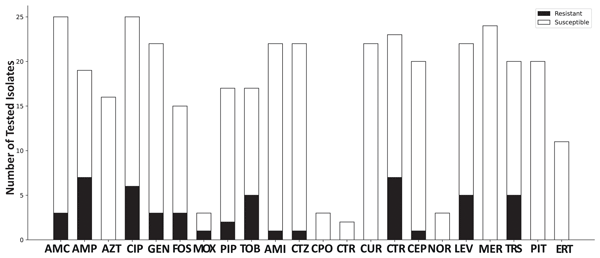
Pseudomonas aeruginosa is a common pathogen in Gram-negative periprosthetic joint infections (PJIs). It is resistant to many antibiotics and forms biofilm, making it difficult to treat. We analyzed 1286 patients who underwent 1640 surgeries; among them, 38 patients with 50 procedures had P. aeruginosa. Most infections were chronic, often in hip revisions, with a high failure rate and recurrence. Due to its clinical and microbiological features, P. aeruginosa-related PJIs remain challenging.
Sujeesh Sebastian, Hibah A. Abusulaiman, Veronika Achatz, Matteo Spadini, Jennyfer A. Mitterer, Sebastian Simon, and Jochen G. Hofstaetter
J. Bone Joint Infect., 11, 15–19, https://doi.org/10.5194/jbji-11-15-2026, https://doi.org/10.5194/jbji-11-15-2026, 2026
Short summary
Short summary
A simple, rapid, and low-cost test measuring synovial fluid specific gravity shows high accuracy and excellent specificity for diagnosing hip and knee periprosthetic joint infection. This method can quickly help rule in infections during revision surgeries, making it a practical point-of-care tool, especially in clinics or hospitals with limited resources. Its performance supports use alongside established lab markers for better patient outcomes.
Veronika Achatz, Jennyfer A. Mitterer, Stephanie Huber, Ece Akcicek, Selma Tobudic, Sujeesh Sebastian, and Jochen G. Hofstaetter
J. Bone Joint Infect., 10, 265–275, https://doi.org/10.5194/jbji-10-265-2025, https://doi.org/10.5194/jbji-10-265-2025, 2025
Short summary
Short summary
Proteus is a rare form of bacteria in periprosthetic joint infection (PJI) following knee and hip arthroplasties. In this study, we investigated culture-positive revision surgeries from 2008 until 2024. Proteus species were mainly found in hip arthroplasties. Furthermore, the infections of Proteus species were mainly prevalent in chronic revisions alongside multiple bacteria. Given their chronic and polymicrobial nature, the outcome of Proteus-associated PJIs is poor.
Sebastian Simon, Marjan Wouthuyzen-Bakker, Susana Gardete Hartmann, Jennyfer A. Mitterer, Sujeesh Sebastian, Stephanie Huber, Bernhard J. H. Frank, and Jochen G. Hofstaetter
J. Bone Joint Infect., 10, 51–59, https://doi.org/10.5194/jbji-10-51-2025, https://doi.org/10.5194/jbji-10-51-2025, 2025
Short summary
Short summary
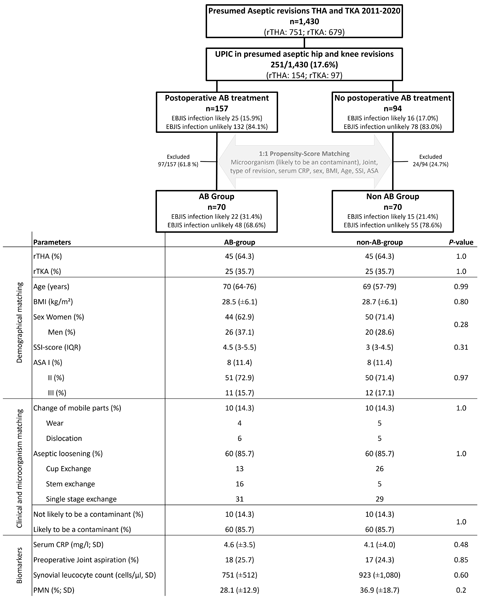
We compared the re-revision rates in rTHA and rTKA (revison total hip and knee arthroplasty) with and without AB (antibiotic) treatment in patients with UPICs (unexpected positive intraoperative cultures). The re-revision rate between the AB group and the non-AB group was similar. Postoperative AB treatment did not result in a decreased re-revision rate in patients with UPICs in presumed aseptic rTHA and rTKA. Patients with pathogens classified as a likely contaminant can be safely ignored.
Cited articles
Abuelnour, M., McNamee, C., Rafi, A. B., Hohlbein, W., Keogh, P., and Cashman, J.: Mid-term to long-term outcome and risk factors for failure of 158 hips with two-stage revision for periprosthetic hip joint infection, J. Bone Joint Infect., 10, 15–24, https://doi.org/10.5194/jbji-10-15-2025, 2025.
Acuña, A. J., Do, M. T., Samuel, L. T., Grits, D., Otero, J. E., and Kamath, A. F.: Periprosthetic joint infection rates across primary total hip arthroplasty surgical approaches: a systematic review and meta-analysis of 653,633 procedures, Arch. Orthop. Trauma Surg., 142, 2965–2977, https://doi.org/10.1007/s00402-021-04186-3, 2021.
Aichmair, A., Frank, B. J. H., Singer, G., Simon, S., Dominkus, M., and Hofstaetter, J. G.: Differential microbiological spectrum and resistance pattern in periprosthetic hip joint infections: a matched-cohort analysis comparing direct anterior versus lateral approach, BMC Musculoskelet. Disord., 23, 72, https://doi.org/10.1186/s12891-022-05037-x, 2022.
Australian Orthopaedic Association National Joint Replacement Registry: Australian Orthopaedic Association National Joint Replacement Registry, 211ff pp., https://doi.org/10.25310/GLOL7776, 2024.
Carli, A. V., Poitras, S., Clohisy, J. C., and Beaulé, P. E.: Variation in Use of Postoperative Precautions and Equipment Following Total Hip Arthroplasty: A Survey of the AAHKS and CAS Membership, J. Arthroplasty, 33, 3201–3205, https://doi.org/10.1016/j.arth.2018.05.043, 2018.
Chalhoub, R., Aoun, M., Nham, F. H., Kassis, E., Daher, M., and El-Othmani, M. M.: Trends and Insights in Direct Anterior Total Hip Arthroplasty: A Comprehensive Bibliometric Analysis, Hip Pelvis, 37, 53–63, https://doi.org/10.5371/hp.2025.37.1.53, 2025.
Chalmers, B. P., Puri, S., Watkins, A., Cororaton, A. D., Miller, A. O., Carli, A. V., and Alexiades, M. M.: No Difference in the Rate of Periprosthetic Joint Infection in Patients Undergoing the Posterolateral Compared to the Direct Anterior Approach, J. Arthroplasty, 38, 1089–1095, https://doi.org/10.1016/j.arth.2023.03.003, 2023.
Charney, M., Paxton, E. W., Stradiotto, R., Lee, J. J., Hinman, A. D., Sheth, D. S., and Prentice, H. A.: A Comparison of Risk of Dislocation and Cause-Specific Revision Between Direct Anterior and Posterior Approach Following Elective Cementless Total Hip Arthroplasty, J. Arthroplasty, 35, 1651–1657, https://doi.org/10.1016/j.arth.2020.01.033, 2020.
Corona, P. S., Vicente, M., Carrera, L., Rodríguez-Pardo, D., and Corró, S.: Current actual success rate of the two-stage exchange arthroplasty strategy in chronic hip and knee periprosthetic joint infection, Bone Joint J., 102-B, 1682–1688, https://doi.org/10.1302/0301-620X.102B12.BJJ-2020-0792.R1, 2020.
Finucane, L. M., Downie, A., Mercer, C., Greenhalgh, S. M., Boissonnault, W. G., Pool-Goudzwaard, A. L., Beneciuk, J. M., Leech, R. L., and Selfe, J.: International Framework for Red Flags for Potential Serious Spinal Pathologies, J. Orthop. Sport. Phys. Ther., 50, 350–372, https://doi.org/10.2519/jospt.2020.9971, 2020.
Goh, G. S., Neumann, M., Salber, J., Gehrke, T., and Citak, M.: One-Stage Revision Total Hip Arthroplasty for Polymicrobial Periprosthetic Joint Infection Leads to High Reinfection Rates: A Mean of 5-Year Follow-Up, J. Arthroplasty, https://doi.org/10.1016/j.arth.2025.06.048, 2025.
Goumenos, S., Hardt, S., Kontogeorgakos, V., Trampuz, A., Perka, C., and Meller, S.: Success Rate After 2-Stage Spacer-Free Total Hip Arthroplasty Exchange and Risk Factors for Reinfection: A Prospective Cohort Study of 187 Patients, J. Arthroplasty, 39, 2600–2606, https://doi.org/10.1016/j.arth.2024.05.010, 2024.
Harmer, J. R., Wyles, C. C., Larson, D. R., Taunton, M. J., Pagnano, M. W., and Abdel, M. P.: Changing Surgical Approach From Primary to Revision Total Hip Arthroplasty Is Not Associated With Increased Risk of Dislocation or Re-Revisions, J. Arthroplasty, 37, S622–S627, https://doi.org/10.1016/j.arth.2022.03.007, 2022.
Hartman, C. W., Daubach, E. C., Richard, B. T., Lyden, E. R., Haider, H., Kildow, B. J., Konigsberg, B. S., and Garvin, K. L.: Predictors of Reinfection in Prosthetic Joint Infections Following Two-Stage Reimplantation, J. Arthroplasty, 37, S674–S677, https://doi.org/10.1016/j.arth.2022.03.017, 2022.
Jaubert, M., Le Baron, M., Jacquet, C., Couvreur, A., Fabre-Aubrespy, M., Flecher, X., Ollivier, M., and Argenson, J.-N.: Failure analysis of articulating polymethyl methacrylate spacers in two-stage revision total hip arthroplasty., Bone Jt. Open, 3, 485–494, https://doi.org/10.1302/2633-1462.36.BJO-2022-0024.R1, 2022.
Jones, C. W., Selemon, N., Nocon, A., Bostrom, M., Westrich, G., and Sculco, P. K.: The Influence of Spacer Design on the Rate of Complications in Two-Stage Revision Hip Arthroplasty, J. Arthroplasty, 34, 1201–1206, https://doi.org/10.1016/j.arth.2019.02.012, 2019.
Kandel, C. E., Jenkinson, R., Daneman, N., Backstein, D., Hansen, B. E., Muller, M. P., Katz, K. C., Widdifield, J., Bogoch, E., Ward, S., Sajja, A., Jeldes, F. G., and McGeer, A.: Predictors of Treatment Failure for Hip and Knee Prosthetic Joint Infections in the Setting of 1- and 2-Stage Exchange Arthroplasty: A Multicenter Retrospective Cohort, Open Forum Infect. Dis., 6, https://doi.org/10.1093/ofid/ofz452, 2019.
Kort, N. P., Zagra, L., Barrena, E. G., Tandogan, R. N., Thaler, M., Berstock, J. R., and Karachalios, T.: Resuming hip and knee arthroplasty after COVID-19: ethical implications for wellbeing, safety and the economy, HIP Int., 30, 492–499, https://doi.org/10.1177/1120700020941232, 2020.
Leibovitch, L., Machinski, E., Fernandes, A., Park, J. Y., Souza, G., Sayudo, I. F., Warschawski, Y., and Gusmao, C.: Direct anterior vs other surgical approaches in patients with lumbar stiffness undergoing total hip arthroplasty: a systematic review and meta-analysis, Arch. Orthop. Trauma Surg., 145, 48, https://doi.org/10.1007/s00402-024-05682-y, 2024.
Lenguerrand, E., Whitehouse, M. R., Beswick, A. D., Kunutsor, S. K., Webb, J. C. J., Mehendale, S., Porter, M., Blom, A. W., and National Joint Registry for England, Wales, Northern Ireland, the Isle of Man, and the National Joint Registry for England, Wales, Northern Ireland, the Isle of Man, and the States of Guernsey: Mortality and re-revision following single-stage and two-stage revision surgery for the management of infected primary hip arthroplasty in England and Wales., Bone Joint Res., 12, 321–330, https://doi.org/10.1302/2046-3758.125.BJR-2022-0131.R1, 2023.
Li, C., Renz, N., Trampuz, A., and Ojeda-Thies, C.: Twenty common errors in the diagnosis and treatment of periprosthetic joint infection, Int. Orthop., 44, 3–14, https://doi.org/10.1007/s00264-019-04426-7, 2020.
Manrique, J., Chen, A. F., Heller, S., and Hozack, W. J.: Direct anterior approach for revision total hip arthroplasty., Ann. Transl. Med., 2, 100, https://doi.org/10.3978/j.issn.2305-5839.2014.09.11, 2014.
McAlister, I. P., Perry, K. I., Mara, K. C., Hanssen, A. D., Berry, D. J., and Abdel, M. P.: Two-Stage Revision of Total Hip Arthroplasty for Infection Is Associated with a High Rate of Dislocation, J. Bone Jt. Surg., 101, 322–329, https://doi.org/10.2106/JBJS.18.00124, 2019.
Mitterer, J. A., Frank, B. J. H., Sebastian, S., Guger, M., Schoefberger, L., and Hofstaetter, J. G.: The Value of Preoperative Ultrasound-Determined Fluid Film and Joint Aspiration in Revision Hip Arthroplasty, J. Arthroplasty, https://doi.org/10.1016/j.arth.2023.10.029, 2023.
Mitterer, J. A., Kinsky, R. M., Frank, B., Aichmair, A., Dominkus, M., and Hofstaetter, J. G.: Comparison of Cutibacterium Avidum versus Acnes in Periprosthetic Hip Infections: A Matched Cohort Analysis, J. Arthroplasty, https://doi.org/10.1016/j.arth.2025.09.052, 2025.
Neumann, D. R. P., Hofstaedter, T., List, C., and Dorn, U.: Two-Stage Cementless Revision of Late Total Hip Arthroplasty Infection Using a Premanufactured Spacer, J. Arthroplasty, 27, 1397–1401, https://doi.org/10.1016/j.arth.2011.10.022, 2012.
Petis, S. M., Abdel, M. P., Perry, K. I., Mabry, T. M., Hanssen, A. D., and Berry, D. J.: Long-Term Results of a 2-Stage Exchange Protocol for Periprosthetic Joint Infection Following Total Hip Arthroplasty in 164 Hips, J. Bone Jt. Surg., 101, 74–84, https://doi.org/10.2106/JBJS.17.01103, 2019.
Piuzzi, N., Yost, L., Putnam, W., Springer, B., de Beaubien, B., Urish, K., and Parvizi, J.: Outcomes following planned two-stage exchange arthroplasty for periprosthetic joint infections in the United States: a systematic review of the literature, Arch. Orthop. Trauma Surg., 145, 352, https://doi.org/10.1007/s00402-025-05955-0, 2025.
Sambri, A., Fiore, M., Rondinella, C., Morante, L., Paolucci, A., Giannini, C., Alfonso, C., and De Paolis, M.: Mechanical complications of hip spacers: a systematic review of the literature., Arch. Orthop. Trauma Surg., 143, 2341–2353, https://doi.org/10.1007/s00402-022-04427-z, 2023.
Scuderi, G. R., Tamer, P., Nace, J., and Mont, M. A.: Management of Periprosthetic Joint Infections: Understanding the Numbers: 1-, 1.5-, and 2-Stage Revisions, J. Arthroplasty, 40, 1936–1937, https://doi.org/10.1016/j.arth.2025.06.036, 2025.
Shohat, N., Bauer, T., Buttaro, M., Budhiparama, N., Cashman, J., Della Valle, C. J., Drago, L., Gehrke, T., Marcelino Gomes, L. S., Goswami, K., Hailer, N. P., Han, S. B., Higuera, C. A., Inaba, Y., Jenny, J.-Y., Kjaersgaard-Andersen, P., Lee, M., Llinás, A., Malizos, K., Mont, M. A., Jones, R. M., Parvizi, J., Peel, T., Rivero-Boschert, S., Segreti, J., Soriano, A., Sousa, R., Spangehl, M., Tan, T. L., Tikhilov, R., Tuncay, I., Winkler, H., Witso, E., Wouthuyzen-Bakker, M., Young, S., Zhang, X., Zhou, Y., and Zimmerli, W.: Hip and Knee Section, What is the Definition of a Periprosthetic Joint Infection (PJI) of the Knee and the Hip? Can the Same Criteria be Used for Both Joints?: Proceedings of International Consensus on Orthopedic Infections, J. Arthroplasty, 34, S325–S327, https://doi.org/10.1016/j.arth.2018.09.045, 2019.
SIRIS Foundation and ANQ: Swiss National Hip and Knee Joint Registry: Annual Report 2024, Institute of Social and Preventive Medicine (ISPM), University of Bern, SwissRDL, pp. 61, https://www.siris-implant.ch/en/Downloads&category=16 (last access: 19 August 2026), 2024.
Sousa, R., Ribau, A., Alfaro, P., Burch, M.-A., Ploegmakers, J., McNally, M., Clauss, M., Wouthuyzen-Bakker, M., and Soriano, A.: The European Bone and Joint Infection Society definition of periprosthetic joint infection is meaningful in clinical practice: a multicentric validation study with comparison with previous definitions, Acta Orthop., 94, 8–18, https://doi.org/10.2340/17453674.2023.5670, 2023.
Thakrar, R. R., Horriat, S., Kayani, B., and Haddad, F. S.: Indications for a single-stage exchange arthroplasty for chronic prosthetic joint infection, Bone Joint J., 101-B, 19–24, https://doi.org/10.1302/0301-620X.101B1.BJJ-2018-0374.R1, 2019.
Thaler, M., Lechner, R., Dammerer, D., Leitner, H., Khosravi, I., and Nogler, M.: The direct anterior approach: treating periprosthetic joint infection of the hip using two-stage revision arthroplasty, Arch. Orthop. Trauma Surg., 140, 255–262, https://doi.org/10.1007/s00402-019-03317-1, 2020.
Triantafyllopoulos, G. K., Memtsoudis, S. G., Zhang, W., Ma, Y., Sculco, T. P., and Poultsides, L. A.: Periprosthetic Infection Recurrence After 2-Stage Exchange Arthroplasty: Failure or Fate?, J. Arthroplasty, 32, 526–531, https://doi.org/10.1016/j.arth.2016.08.002, 2017.
Tsung, J. D., Rohrsheim, J. A. L., Whitehouse, S. L., Wilson, M. J., and Howell, J. R.: Management of Periprosthetic Joint Infection After Total Hip Arthroplasty Using a Custom Made Articulating Spacer (CUMARS); the Exeter Experience, J. Arthroplasty, 29, 1813–1818, https://doi.org/10.1016/j.arth.2014.04.013, 2014.
Wernecke, G. C., Jin, X. Z., Lin, J.-L., and Harris, I. A.: The Impact of Surgical Approach on 90-Day Prosthetic Joint Infection After Total Hip Replacement – A Population-Based, Propensity Score-Matched Cohort Study, J. Arthroplasty, 39, 151–156, https://doi.org/10.1016/j.arth.2023.06.033, 2024.
Wilson, J. M., Hadley, M. L., Larson, D., Ledford, C. K., Bingham, J. S., Wyles, C. C., and Taunton, M. J.: Outcomes Following Direct Anterior Approach Total Hip Arthroplasty, J. Bone Jt. Surg., 107, 356–363, https://doi.org/10.2106/JBJS.24.00132, 2025.
Zahar, A., Klaber, I., Gerken, A.-M., Gehrke, T., Gebauer, M., Lausmann, C., and Citak, M.: Ten-Year Results Following One-Stage Septic Hip Exchange in the Management of Periprosthetic Joint Infection, J. Arthroplasty, 34, 1221–1226, https://doi.org/10.1016/j.arth.2019.02.021, 2019.
Short summary
Two-stage septic revision was evaluated in 36 / 8476 (0.4 %) patients after primary total hip arthroplasty (THA) using the direct anterior approach (DAA). Infection-free survival was 77.8 % after a median follow-up of 6 years. Spacer-related complications occurred in 5.6 %. Revision for dislocation after reimplantation occurred in 8.3 %. Two-stage septic revision using the DAA shows reinfection rates comparable to other approaches, with low rates of spacer dislocation and postoperative dislocation after reimplantation.
Two-stage septic revision was evaluated in 36 / 8476 (0.4 %) patients after primary total hip...