Articles | Volume 11, issue 1
https://doi.org/10.5194/jbji-11-15-2026
© Author(s) 2026. This work is distributed under
the Creative Commons Attribution 4.0 License.
https://doi.org/10.5194/jbji-11-15-2026
© Author(s) 2026. This work is distributed under
the Creative Commons Attribution 4.0 License.
Synovial fluid specific gravity as an inexpensive point-of-care test for diagnosing hip and knee periprosthetic joint infection
Sujeesh Sebastian
Michael Ogon Laboratory for Orthopaedic Research, Orthopaedic Hospital Vienna-Speising, Speisinger Straße 109, 1130 Vienna, Austria
Hibah A. Abusulaiman
Michael Ogon Laboratory for Orthopaedic Research, Orthopaedic Hospital Vienna-Speising, Speisinger Straße 109, 1130 Vienna, Austria
Veronika Achatz
Michael Ogon Laboratory for Orthopaedic Research, Orthopaedic Hospital Vienna-Speising, Speisinger Straße 109, 1130 Vienna, Austria
Department of Orthopaedics and Trauma, Medical University of Graz, Auenbruggerplatz 5, Graz, Austria
Matteo Spadini
Michael Ogon Laboratory for Orthopaedic Research, Orthopaedic Hospital Vienna-Speising, Speisinger Straße 109, 1130 Vienna, Austria
Jennyfer A. Mitterer
Michael Ogon Laboratory for Orthopaedic Research, Orthopaedic Hospital Vienna-Speising, Speisinger Straße 109, 1130 Vienna, Austria
Sebastian Simon
Michael Ogon Laboratory for Orthopaedic Research, Orthopaedic Hospital Vienna-Speising, Speisinger Straße 109, 1130 Vienna, Austria
2nd Department, Orthopaedic Hospital Vienna-Speising, Speisinger Straße 109, 1130 Vienna, Austria
Related authors
Sebastian Simon, Jennyfer A. Mitterer, Bernhard J. H. Frank, Stephanie Huber, Sujeesh Sebastian, Susana Gardete-Hartmann, and Jochen G. Hofstaetter
J. Bone Joint Infect., 11, 513–521, https://doi.org/10.5194/jbji-11-513-2026, https://doi.org/10.5194/jbji-11-513-2026, 2026
Short summary
Short summary
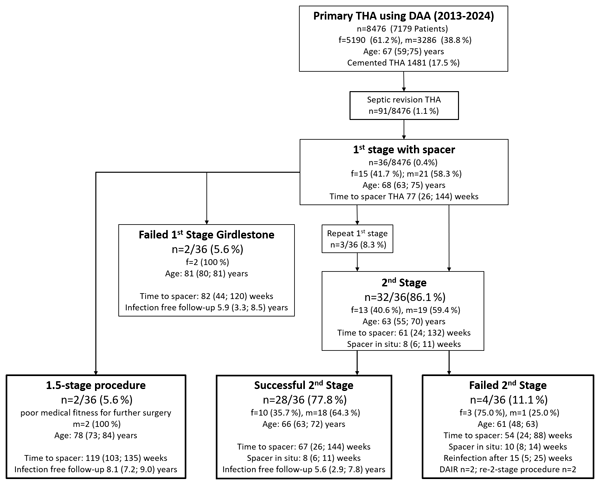
Two-stage septic revision was evaluated in 36 / 8476 (0.4 %) patients after primary total hip arthroplasty (THA) using the direct anterior approach (DAA). Infection-free survival was 77.8 % after a median follow-up of 6 years. Spacer-related complications occurred in 5.6 %. Revision for dislocation after reimplantation occurred in 8.3 %. Two-stage septic revision using the DAA shows reinfection rates comparable to other approaches, with low rates of spacer dislocation and postoperative dislocation after reimplantation.
Ece Akcicek, Jennyfer A. Mitterer, Veronika Achatz, Tamino Szirmay, Sujeesh Sebastian, and Jochen G. Hofstaetter
J. Bone Joint Infect., 11, 83–94, https://doi.org/10.5194/jbji-11-83-2026, https://doi.org/10.5194/jbji-11-83-2026, 2026
Short summary
Short summary
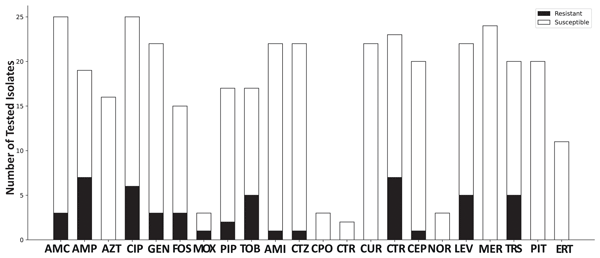
Pseudomonas aeruginosa is a common pathogen in Gram-negative periprosthetic joint infections (PJIs). It is resistant to many antibiotics and forms biofilm, making it difficult to treat. We analyzed 1286 patients who underwent 1640 surgeries; among them, 38 patients with 50 procedures had P. aeruginosa. Most infections were chronic, often in hip revisions, with a high failure rate and recurrence. Due to its clinical and microbiological features, P. aeruginosa-related PJIs remain challenging.
Veronika Achatz, Jennyfer A. Mitterer, Stephanie Huber, Ece Akcicek, Selma Tobudic, Sujeesh Sebastian, and Jochen G. Hofstaetter
J. Bone Joint Infect., 10, 265–275, https://doi.org/10.5194/jbji-10-265-2025, https://doi.org/10.5194/jbji-10-265-2025, 2025
Short summary
Short summary
Proteus is a rare form of bacteria in periprosthetic joint infection (PJI) following knee and hip arthroplasties. In this study, we investigated culture-positive revision surgeries from 2008 until 2024. Proteus species were mainly found in hip arthroplasties. Furthermore, the infections of Proteus species were mainly prevalent in chronic revisions alongside multiple bacteria. Given their chronic and polymicrobial nature, the outcome of Proteus-associated PJIs is poor.
Sebastian Simon, Marjan Wouthuyzen-Bakker, Susana Gardete Hartmann, Jennyfer A. Mitterer, Sujeesh Sebastian, Stephanie Huber, Bernhard J. H. Frank, and Jochen G. Hofstaetter
J. Bone Joint Infect., 10, 51–59, https://doi.org/10.5194/jbji-10-51-2025, https://doi.org/10.5194/jbji-10-51-2025, 2025
Short summary
Short summary
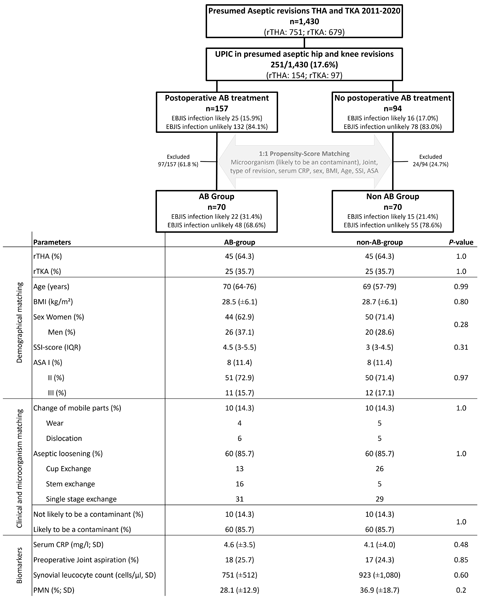
We compared the re-revision rates in rTHA and rTKA (revison total hip and knee arthroplasty) with and without AB (antibiotic) treatment in patients with UPICs (unexpected positive intraoperative cultures). The re-revision rate between the AB group and the non-AB group was similar. Postoperative AB treatment did not result in a decreased re-revision rate in patients with UPICs in presumed aseptic rTHA and rTKA. Patients with pathogens classified as a likely contaminant can be safely ignored.
Sebastian Simon, Jennyfer A. Mitterer, Bernhard J. H. Frank, Stephanie Huber, Sujeesh Sebastian, Susana Gardete-Hartmann, and Jochen G. Hofstaetter
J. Bone Joint Infect., 11, 513–521, https://doi.org/10.5194/jbji-11-513-2026, https://doi.org/10.5194/jbji-11-513-2026, 2026
Short summary
Short summary
Two-stage septic revision was evaluated in 36 / 8476 (0.4 %) patients after primary total hip arthroplasty (THA) using the direct anterior approach (DAA). Infection-free survival was 77.8 % after a median follow-up of 6 years. Spacer-related complications occurred in 5.6 %. Revision for dislocation after reimplantation occurred in 8.3 %. Two-stage septic revision using the DAA shows reinfection rates comparable to other approaches, with low rates of spacer dislocation and postoperative dislocation after reimplantation.
Ece Akcicek, Jennyfer A. Mitterer, Veronika Achatz, Tamino Szirmay, Sujeesh Sebastian, and Jochen G. Hofstaetter
J. Bone Joint Infect., 11, 83–94, https://doi.org/10.5194/jbji-11-83-2026, https://doi.org/10.5194/jbji-11-83-2026, 2026
Short summary
Short summary
Pseudomonas aeruginosa is a common pathogen in Gram-negative periprosthetic joint infections (PJIs). It is resistant to many antibiotics and forms biofilm, making it difficult to treat. We analyzed 1286 patients who underwent 1640 surgeries; among them, 38 patients with 50 procedures had P. aeruginosa. Most infections were chronic, often in hip revisions, with a high failure rate and recurrence. Due to its clinical and microbiological features, P. aeruginosa-related PJIs remain challenging.
Veronika Achatz, Jennyfer A. Mitterer, Stephanie Huber, Ece Akcicek, Selma Tobudic, Sujeesh Sebastian, and Jochen G. Hofstaetter
J. Bone Joint Infect., 10, 265–275, https://doi.org/10.5194/jbji-10-265-2025, https://doi.org/10.5194/jbji-10-265-2025, 2025
Short summary
Short summary
Proteus is a rare form of bacteria in periprosthetic joint infection (PJI) following knee and hip arthroplasties. In this study, we investigated culture-positive revision surgeries from 2008 until 2024. Proteus species were mainly found in hip arthroplasties. Furthermore, the infections of Proteus species were mainly prevalent in chronic revisions alongside multiple bacteria. Given their chronic and polymicrobial nature, the outcome of Proteus-associated PJIs is poor.
Sebastian Simon, Marjan Wouthuyzen-Bakker, Susana Gardete Hartmann, Jennyfer A. Mitterer, Sujeesh Sebastian, Stephanie Huber, Bernhard J. H. Frank, and Jochen G. Hofstaetter
J. Bone Joint Infect., 10, 51–59, https://doi.org/10.5194/jbji-10-51-2025, https://doi.org/10.5194/jbji-10-51-2025, 2025
Short summary
Short summary
We compared the re-revision rates in rTHA and rTKA (revison total hip and knee arthroplasty) with and without AB (antibiotic) treatment in patients with UPICs (unexpected positive intraoperative cultures). The re-revision rate between the AB group and the non-AB group was similar. Postoperative AB treatment did not result in a decreased re-revision rate in patients with UPICs in presumed aseptic rTHA and rTKA. Patients with pathogens classified as a likely contaminant can be safely ignored.
Cited articles
Akhbari, P., Jaggard, M. K., Boulangé, C. L., Vaghela, U., Graça, G., Bhattacharya, R., Lindon, J. C., Williams, H. R. T., and Gupte, C. M.: Differences between Infected and Noninfected Synovial Fluid: An Observational Study Using Metabolic Phenotyping (or “metabonomics”), Bone Joint. Research, 10, 85–95, https://doi.org/10.1302/2046-3758.101.BJR-2020-0285.R1, 2021.
Amanatullah, D. F., Cheng, R. Z., Huddleston, J. I. I., Maloney, W. J., Finlay, A. K., Kappagoda, S., Suh, G. A., and Goodman, S. B.: The routine use of synovial alpha-defensin is not necessary, Bone. Joint. J., 102-B, 593–599, https://doi.org/10.1302/0301-620X.102B5.BJJ-2019-0473.R3, 2020.
de Paula Mozella, A., Alexandre de Araujo Barros Cobra, H., Monteiro da Palma, I., Salim, R., Antonio Matheus Guimarães, J., Costa, G., and Carolina Leal, A.: Synovial fluid NMR-based metabolomics in septic and aseptic revision total knee arthroplasty: Implications on diagnosis and treatment, J. Orthop. Res., 42, 2336–2344, https://doi.org/10.1002/JOR.25870, 2024.
Faryna, A. and Goldenberg, K.: Joint Fluid, in: Clinical Methods: The History, Physical, and Laboratory Examinations, edited by: Walker, H. K., Hall, W. D., and Hurst, J. W., Butterworths, Boston, USA, 773–776, https://www.ncbi.nlm.nih.gov/books/NBK274/ (last access: 27 October 2025), 1990.
Fu, J., Ni, M., Chai, W., Li, X., Hao, L., and Chen, J.: Synovial Fluid Viscosity Test is Promising for the Diagnosis of Periprosthetic Joint Infection, J. Arthroplasty, 34, 1197–1200, https://doi.org/10.1016/j.arth.2019.02.009, 2019.
Li, H., Li, R., Erlong, N., Chai, W., Hao, L., Xu, C., Fu, J., Chen, J., and Zhu, F.: It can be unnecessary to combine common synovial fluid analysis and alpha-defensin tests for periprosthetic joint infection diagnosis, BMC Musculoskelet. Disord., 29, 529–541, https://doi.org/10.1186/s12891-023-06594-5, 2023.
MacWilliams, P. S. and Friedrichs, K. R.: Laboratory evaluation and interpretation of synovial fluid, Vet. Clin. North. Am. Small. Anim. Pract., 33, 153–178, https://doi.org/10.1016/s0195-5616(02)00083-9, 2003.
McNally, M., Sousa, R., Wouthuyzen-Bakker, M., Chen, A. F., Soriano, A., Vogely, H. C., Clauss, M., Higuera, C. A., and Trebše, R.: The EBJIS definition of periprosthetic joint infection, Bone Joint. J., 103-B, 18–25, https://doi.org/10.1302/0301-620X.103B1.BJJ-2020-1381.R1, 2021.
Roškar, S., Mihalič, R., Mihelič, A., and Trebše, R.: Synovial fluid viscosity with synovial fluid cell count, valuable diagnostic marker of prosthetic joint infections, Sci. Rep., 15, 16223–16233, https://doi.org/10.1038/s41598-025-00760-6, 2025.
Sebastian, S., Mitterer, J. A., Ahmed, Y., Frank, B. J. H., Simon, S., and Hofstaetter, J. G.: Clinical Benefit of Using Differential Cutoff Values of Synovial C-Reactive Protein in Acute and Chronic Infected as Well as Aseptic Hip and Knee Revision Arthroplasties, J. Arthroplasty, 40, 2706–2714, https://doi.org/10.1016/j.arth.2025.04.011, 2025.
Sendi, P., Müller, A. M., and Berbari, E.: Are All Joints Equal? Synovial Fluid Analysis in Periprosthetic Joint Infection, J. Bone Joint Infect., 3, 258–259, https://doi.org/10.7150/jbji.30491, 2018.
Shohat, N., Bauer, T., Buttaro, M., Budhiparama, N., Cashman, J., Della Valle, C. J., Drago, L., Gehrke, T., Marcelino Gomes, L. S., Goswami, K., Hailer, N. P., Han, S. B., Higuera, C. A., Inaba, Y., Jenny, J. Y., Kjaersgaard-Andersen, P., Lee, M., Llinás, A., Malizos, K., Mont, M. A., Jones, R. M., Parvizi, J., Peel, T., Rivero-Boschert, S., Segreti, J., Soriano, A., Sousa, R., Spangehl, M., Tan, T. L., Tikhilov, R., Tuncay, I., Winkler, H., Witso, E., Wouthuyzen-Bakker, M., Young, S., Zhang, X., Zhou, Y., and Zimmerli, W.: Hip and Knee Section, What is the Definition of a Periprosthetic Joint Infection (PJI) of the Knee and the Hip? Can the Same Criteria be Used for Both Joints?: Proceedings of International Consensus on Orthopedic Infections, J. Arthroplasty, 34, S325–S327, https://doi.org/10.1016/j.arth.2018.09.045, 2019.
Sowislok, A., Busch, A., Kaschani, F., Kaiser, M., and Jäger, M.: Differences in the Synovial Fluid Proteome of Septic and Aseptic Implant Failure, Antibiotics, 13, 346–361, https://doi.org/10.3390/ANTIBIOTICS13040346/S1, 2024
Yehia, S. R. and Duncan, H.: Synovial Fluid Analysis, Clin. Orthop. Relat. Res., 107, 11–24, https://doi.org/10.1097/00003086-197503000-00003, 1975.
Short summary
A simple, rapid, and low-cost test measuring synovial fluid specific gravity shows high accuracy and excellent specificity for diagnosing hip and knee periprosthetic joint infection. This method can quickly help rule in infections during revision surgeries, making it a practical point-of-care tool, especially in clinics or hospitals with limited resources. Its performance supports use alongside established lab markers for better patient outcomes.
A simple, rapid, and low-cost test measuring synovial fluid specific gravity shows high accuracy...